Radiofrequency ablation · St. Louis
Radiofrequency ablation disables a nerve on purpose. It reconnects on its own timeline, and that is not a design flaw.
Radiofrequency ablation uses heat to disable a medial branch nerve already confirmed by diagnostic blocks. It turns off a facet joint’s pain signal for months at a time.
Who is a candidate for radiofrequency ablation?
This procedure does not stand on its own. It follows a medial branch block that gave concordant, duration-matched relief (relief in the right spot, lasting as long as the numbing drug should) on two separate occasions. Not one good afternoon. Not a patient’s belief about which joint hurts. That order exists for a reason this page will spend the next few sections defending: the outcomes of ablation track the rigor of the diagnosis that came before it, almost exactly.
How does radiofrequency ablation work?
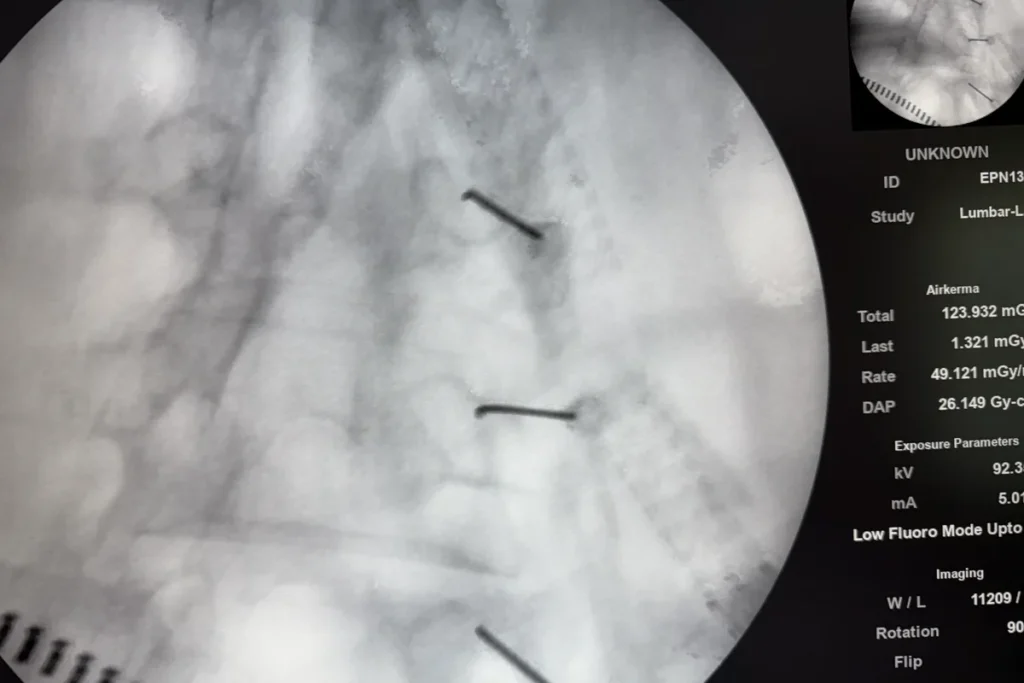
A thin probe is placed alongside the same medial branch nerve found during the diagnostic blocks. Its position is confirmed under fluoroscopy (live X-ray), often with a sensory and motor stimulation test before any heat is applied. The tip is then heated to roughly 80°C for about ninety seconds. That makes a small heat lesion that interrupts the nerve’s ability to carry pain signal from that joint. It is targeted, it is measured, and it is not guesswork — but it is also not a repair. The joint underneath is unchanged. Only its ability to report pain has been switched off.
How long does radiofrequency ablation last?
Peripheral nerves grow back. That is not a defect in the procedure. It is a basic property of the tissue being treated. It is the honest answer to why relief from a single ablation typically runs somewhere from nine months to just over a year, not forever. The nerve fiber regrows along the path the lesion interrupted, at a pace measured in millimeters per week. Once it reconnects, the joint gets back its line to the brain.
Patients are rarely told this before the first procedure. Then they feel blindsided when relief fades on schedule. It should not be a surprise. It is the expected biology, and it is exactly why we discuss it at the consult, not in month ten.
Can radiofrequency ablation be repeated?
A repeat ablation at the same joint is a reasonable and common next step once relief from the first has clearly faded. It does not require re-running the full diagnostic sequence from zero if the first response was clean and the same pain pattern has come back. What it does require is a check that the returning pain matches the original pattern. A different pain in a similar spot is a different question, not an automatic repeat.
Cooled radiofrequency, and the sacroiliac joint
Standard radiofrequency makes a lesion about the size and shape of the probe tip. Cooled radiofrequency runs fluid through the probe during treatment. That lets a larger, rounder lesion form without overheating the tissue right around it. That matters most where the target nerves do not run in one predictable line. That describes the lateral branches supplying the sacroiliac joint far better than it describes the lumbar medial branches. Cooled technique is the more common choice for SI joint denervation (turning off its nerves) for exactly that anatomy reason, detailed further on the sacroiliac joint injection page.
What the trials found, and why this practice still offers it
The evidence here is not uniform, and it should be said plainly rather than smoothed over. Cohort data follow patients chosen using strict, comparative, duration-matched blocks. They show a large majority getting meaningful, months-long relief — consistent with what this practice requires before going ahead. A widely cited 2017 randomized trial found no significant benefit from radiofrequency denervation over sham treatment in chronic low back pain. It deserves an honest reading, not a dismissal. It enrolled patients using a single diagnostic block, rather than the comparative, duration-matched pair described on the medial branch block page. A single block is known to carry a high false-positive rate. A trial built on a looser diagnostic gate will enroll patients who were never going to respond to a treatment aimed at a nerve that was not their problem. The result reads as a failure of the treatment when it may be a failure of patient selection.
This practice’s position, stated plainly: ablation done on a patient who cleared the stricter diagnostic bar works considerably more often than the mixed trial research as a whole suggests. That is the whole argument for insisting on the double-block protocol rather than skipping to treatment on a patient’s say-so.
What it will not fix
This is not a treatment for radicular pain running down an arm or leg. That is a nerve root problem, addressed with an epidural steroid injection or a different workup entirely, not a medial branch. It is also not right for pain that has not been confirmed with blocks, no matter how sure a scan seems about a joint. The scan is not the diagnosis here. The block is.
What happens during a radiofrequency ablation procedure?
- Positioning and skin prep at the confirmed target level.
- Probe advanced under fluoroscopy alongside the nerve, with position confirmed on imaging and, often, stimulation testing.
- Local anesthetic given at the site before heat is applied, so the lesion itself is not felt.
- Each nerve heated for roughly ninety seconds, repeated at every level confirmed by the blocks.
- No sedation. Short observation, then most patients drive themselves home. Some soreness at the sites for a few days is expected. The pain relief itself typically builds over the next one to three weeks as the irritated nerve settles.
Frequently asked questions
How long will the relief last?
Typically nine months to a little over a year. It varies by patient and by joint, the way pain patterns themselves vary, as described on the facet joint pain page. It ends because the nerve regrows, not because the procedure stopped working the way it was designed to.
Do I need new diagnostic blocks every time?
Not necessarily. If the returning pain matches the original pattern exactly, and the first ablation gave clean, concordant relief, new blocks are not always needed. A different pattern gets re-tested with a fresh medial branch block rather than assumed.
Is this the same thing as an epidural?
These treat two different structures, and people confuse them often. This disables the medial branch nerve behind confirmed facet-joint pain. An epidural treats inflammation around a squeezed nerve root — a different structure and a different kind of pain.
Does it work for sacroiliac joint pain too?
It does, using cooled radiofrequency aimed at the lateral branches rather than the medial branches, after diagnosis with a sacroiliac joint injection. The logic of confirm first, treat second is the same.
Is there a limit on how many times I can have it?
No fixed number. Repeat ablations at the same confirmed joint are common over years. Each is judged case by case against how well the last one worked and how the pain pattern has behaved since — the same case-by-case judgment described on the how long does a nerve block last page.
Is radiofrequency ablation painful?
Local anesthetic is given at each site before any heat is applied, so the lesion itself is not felt. The probe is placed under fluoroscopy, often with a stimulation test to confirm its position, and each nerve is heated for about ninety seconds. Expect some soreness at the treated sites for a few days afterward.
How long does it take to recover from radiofrequency ablation?
No sedation is used. You stay awake under local anesthetic. You go home the same day after a short observation period, and most patients drive themselves home. Normal activity, including work, resumes within two to four hours. If an arm or leg feels weak or numb, have someone else drive until that wears off. Soreness at the treated sites for a few days is expected. The pain relief itself usually builds over the following one to three weeks as the irritated nerve settles, so the first few days are not the final verdict.
What is the success rate of radiofrequency ablation?
It depends on how patients were chosen. Studies that required strict, comparative, duration-matched blocks show a large majority getting meaningful relief that lasts months. A widely cited 2017 trial found no benefit over sham. But it enrolled patients after a single block, which carries a high false-positive rate. That is why we require two matching blocks before we ablate.
What are the downsides of radiofrequency ablation?
Relief is not permanent. The nerve regrows and the pain returns, typically after nine months to just over a year. The joint itself is unchanged, since only its pain signal is switched off. Expect a few days of soreness at the sites. And it does not help pain running down an arm or leg, which comes from a nerve root, not a medial branch.
Related reading
- Medial branch block
- Facet joint pain
- Sacroiliac joint pain
- Failed back surgery syndrome
- How long does a nerve block last?
We will show you the block data before we recommend the burn
Ablation is offered when the diagnosis has earned it, not when a scan makes a joint look guilty. We will walk through your block results and what they do and do not confirm.
4479 Woodson Rd, Suite 401
St. Louis, MO 63134
Next to St. Louis Lambert International Airport, off I-70 at Woodson Road.
Sources
- Schneider BJ et al. Systematic Review of the Effectiveness of Lumbar Medial Branch Thermal Radiofrequency Neurotomy, Stratified for Diagnostic Methods and Procedural Technique. Pain Medicine, 2020. PubMed 32040149
- MacVicar J et al. Lumbar medial branch radiofrequency neurotomy in New Zealand. Pain Medicine, 2013. PubMed 23279154
- Juch JNS et al. Effect of Radiofrequency Denervation on Pain Intensity Among Patients With Chronic Low Back Pain: The Mint Randomized Clinical Trials. JAMA, 2017. PubMed 28672319
- Cohen SP et al. Cooled radiofrequency ablation versus standard medical management for chronic sacroiliac joint pain: a multicenter, randomized comparative effectiveness study. Regional Anesthesia & Pain Medicine, 2024. PubMed 37407279