Herniated disc · St. Louis
A disc can hurt without herniating, and a herniation can sit there silently. The scan alone does not settle which one is yours.
A herniated disc is the disc’s soft inner material pushing through a tear in its tougher outer ring. It hurts in one of two ways. It can touch a nerve root and send pain down a leg or arm, or the tear itself can hurt. And a large share of pain-free adults carry the same MRI finding.
Your MRI says herniation, but a large share of pain-free adults your age carry the same finding. Here is how we find out whether your disc is actually the source, what makes it hurt when it is, and what moves the plan toward surgery.
What is a herniated disc, and why does it hurt?
A disc herniation is nucleus pulposus — the disc’s soft inner material — pushing through a tear in the tougher outer ring, the annulus. Two different things can hurt from there, and they are not the same problem. If the fragment touches a nerve root, you get radicular pain down a leg or arm, covered in full on sciatica. If the tear itself reaches the outer third of the annulus, which has its own nerve supply, you can get deep back pain with no leg symptoms at all. That is discogenic pain, made by the tear rather than by anything touching a nerve. Add a habit on top: nicotine squeezes the small vessels a disc depends on for food. The disc has almost no blood supply of its own and lives on diffusion (fluid seeping in). Smokers heal herniations more slowly and get degenerative disc disease earlier. It is one of the few places where a single habit measurably changes a structural outcome.
Does a herniated disc on an MRI always cause pain?
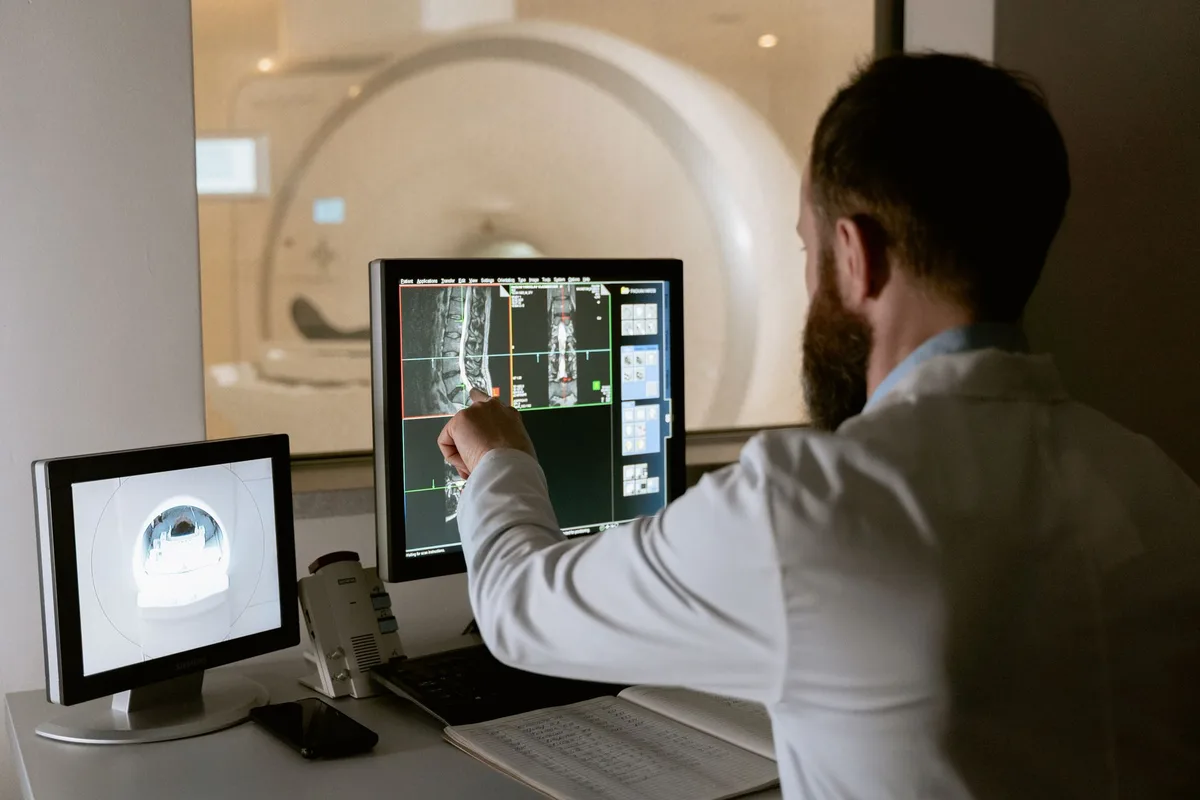
MRI finds disc bulges and even frank herniations in a large share of adults who have never had a day of back pain. That is not a flaw in the machine. It means the image alone cannot tell you which disc is the one talking. We read it against your exam — where the pain is, what brings it on, whether a straight-leg raise or a certain position lights it up — and against the annulus itself. A recent review in Pain Practice makes the case plainly. Discogenic pain, driven by annular tears rather than by frank herniation or nerve compression, is common and often missed on standard scans. It explains a share of the “normal-looking” MRIs that get waved off as unremarkable.
CHEMICAL RADICULITIS
Nucleus pulposus material is inflammatory to nerve tissue on contact, apart from any pressure. A 2021 review in Neurocirugia details how leaked disc material sets off cytokine and inflammatory chain reactions at the root. That is why a small fragment can cause outsized pain. It is also why relief can beat what the compression alone would predict once that chemical part is quieted.
Does a herniated disc heal on its own?
The body sees herniated material as foreign and slowly breaks it down and reabsorbs it. Oddly, this often works best in the largest and most inflammatory extrusions, because more exposed material draws a bigger cleanup crew. A 2024 meta-analysis in Clinical Spine Surgery pooled results across dozens of cohorts. It found roughly two in three herniations show measurable shrinkage without surgery. That is the natural course this practice manages around, not against. An epidural steroid injection does not speed up that cleanup, but it can make the months it takes survivable.
Roughly two in three herniated fragments shrink measurably without surgery — a population finding, not a promise about any one disc.
How does an epidural steroid injection help a herniated disc?
An epidural steroid injection is aimed at the inflammatory part — whether that inflammation comes from a nerve root under chemical attack or from an annular tear sending its own pain signal. It is a treatment for the waiting period. This practice does not pre-book a series; each injection is weighed against what the last one did. Where the pain is confirmed discogenic with no radicular part, the injection target and the plan both change. We make that call before treatment, not after a first injection disappoints.
The terrain feeding the disc
A disc heals on the blood flow and inflammatory signals running through the rest of the body. Insulin resistance and whole-body inflammation push the disc’s chemical irritation up from an already high baseline. They also stall the reabsorption an epidural is meant to buy time for. That is why we draw a blood panel at this visit. It is also why the behavioral half of the plan carries the same weight as the needle. We deliver it in-house through Acceptance and Commitment Therapy. Metabolic health and pain covers the mechanism.
When does a herniated disc need surgery?
For most herniations, surgery is not part of the plan. Conservative care, interventional treatment and time resolve most cases, and a fragment given the chance to be reabsorbed often makes an operation unneeded. A 2020 randomized trial in the New England Journal of Medicine compared surgery to continued conservative care for sciatica lasting four to twelve months. Both approaches ended up with similar outcomes at one year. That argues for patience where patience is medically safe. What does not argue for patience is a deficit that is new or getting worse — a weakening ankle, a foot starting to drop — because nerve function lost to long pressure does not reliably return once the nerve is freed later. When conservative and interventional options have run out and the fragment is not shrinking on its own, this practice performs microdiscectomy. We coordinate the timing with any injections already given.
Red flags, in plain terms
GET SEEN URGENTLY
- New numbness across the saddle area, or trouble starting or controlling urination or bowel movements.
- A foot dropping, or weakness that is measurably worse than it was a few days ago.
- Herniation pain that began with a fall, a collision, or arrives with fever or unexplained weight loss.
Read the full list on when it is an emergency.
Common questions
Do I need a referral to be seen for a herniated disc?
No. Book directly; you do not need a referral or a new MRI to be seen. Some plans want a primary care referral on file before they pay for an epidural, so we verify that ahead of time. Referrals and pain care explains which plans ask.
My MRI shows a herniation but I have no leg pain. Is that normal?
Common. Many herniations never press on a nerve root closely enough to cause radicular symptoms. Axial back pain (pain that stays in the back) in that setting may instead be discogenic, from the annular tear itself; see facet joint pain for the other structure axial back pain gets mistaken for.
Does the herniation ever go away completely?
Often it shrinks enough that it stops mattering, even if a follow-up scan still shows some leftover material; what to expect covers how we track that over a course of care.
Will an epidural fix the herniation?
No. An epidural calms the chemical inflammation around the nerve or the annulus instead. That is what lets you function while the body clears the material; the mechanism is on epidural steroid injection.
How do I know if I need surgery?
Weakness that keeps getting worse is the trigger, not how bad the pain is. If conservative and interventional care have been tried and a deficit is worsening, we discuss microdiscectomy directly, and when injections stop working covers that decision point in general.
Can this happen again after treatment?
The same disc, or the one next to it, can herniate again. That is part of why the terrain matters as much as the event; sleep, movement and behavior covers what actually lowers that risk.
How is a herniated disc diagnosed?
An MRI shows the disc, but the picture alone cannot tell us which disc is causing your pain. We read the scan against your exam: where the pain sits, what brings it on, and whether a straight-leg raise or a certain position sets it off. We also look for a tear in the outer ring, which can hurt without any nerve being touched.
What shouldn’t you do with a herniated disc?
Do not smoke. Nicotine narrows the tiny vessels a disc depends on for nutrition, and smokers heal herniations more slowly. Do not ignore weakness that is new or getting worse, such as a weak ankle or a foot starting to drop, because nerve function lost over time may not come back. And do not let a scan finding alone decide your treatment.
Can I live a normal life with a herniated disc?
Many people already do. A large share of adults with no back pain at all have a herniation on MRI. When a disc does hurt, roughly two in three herniated fragments shrink measurably without surgery. An epidural steroid injection can make those months livable while your body clears the material, and we work on the metabolic health that decides how well the disc heals.
Related reading
- Sciatica
- Spinal stenosis
- Epidural steroid injection
- Failed back surgery syndrome
- After a car accident
Sources
- van Os WKM et al. 14. Discogenic Low Back Pain. Pain Practice, 2025. PubMed 40717265
- Cosamalón-Gan I et al. Inflammation in the intervertebral disc herniation. Neurocirugia, 2021. PubMed 32169419
- Zou T et al. Incidence of Spontaneous Resorption of Lumbar Disc Herniation: A Meta-analysis. Clinical Spine Surgery, 2024. PubMed 37559207
- Bailey CS et al. Surgery versus Conservative Care for Persistent Sciatica Lasting 4 to 12 Months. The New England Journal of Medicine, 2020. PubMed 32187469
We will tell you whether the scan and the exam actually agree
A herniation on a report is a finding, not automatically a diagnosis. We will tell you whether yours explains what you feel before we build a plan around it.
4479 Woodson Rd, Suite 401
St. Louis, MO 63134
Next to St. Louis Lambert International Airport, off I-70 at Woodson Road.