CRPS treatment · St. Louis
With CRPS, your nerves keep broadcasting an emergency long after the fracture healed.
Complex regional pain syndrome (CRPS), also called reflex sympathetic dystrophy (RSD), is what happens when the nervous system’s alarm stays on after the injury that set it off. A sprained ankle or a healed wrist fracture leaves behind a limb that is swollen, discolored, and too painful to touch. It is real. It can be measured. It responds best to treatment started early.
How is CRPS diagnosed?
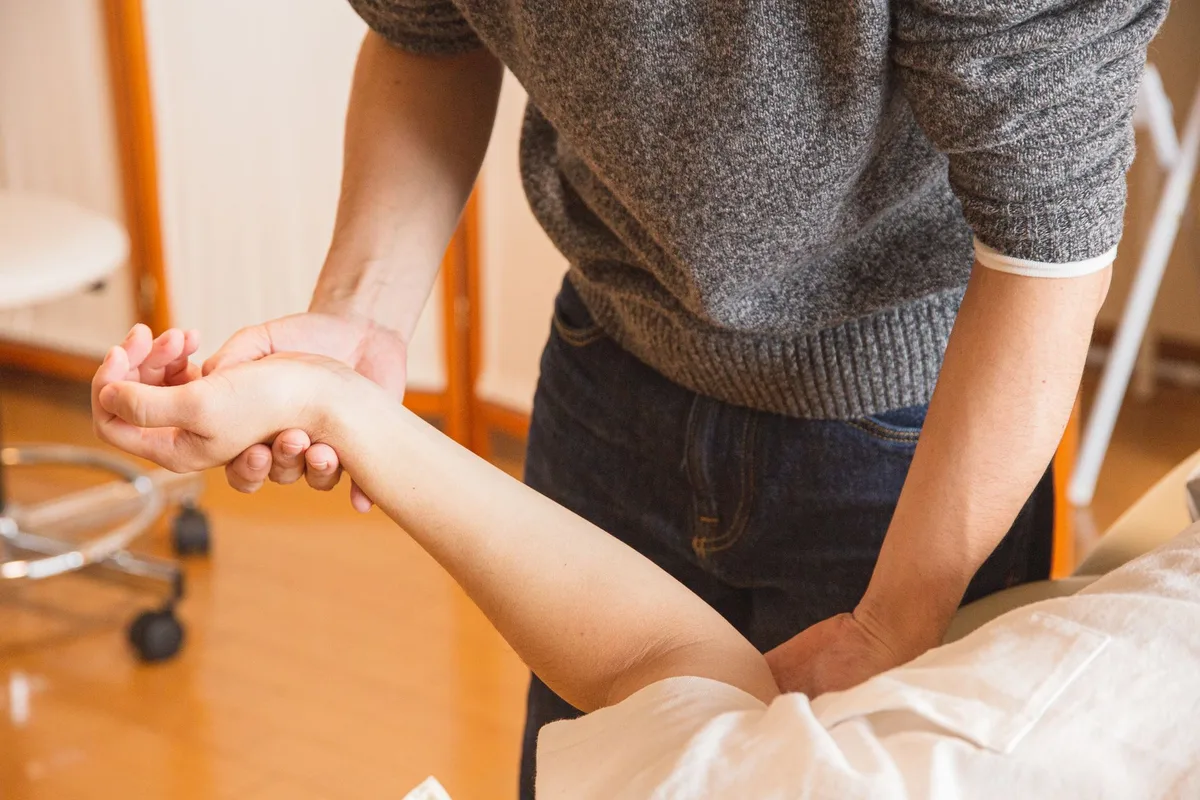
The diagnosis is clinical. We make it at the bedside, using a set of signs called the Budapest criteria. It does not need an MRI, because no scan shows CRPS. In plain terms, the pain has to be out of proportion to whatever started it. The limb also has to show evidence in at least three of four groups. One is a change in temperature or color compared with the other side. One is swelling or sweating that is not the same on both sides. One is a change in hair, nail or skin texture. The last is a change in movement or strength. At least two of those groups have to show up on our exam the day we see you, not just in your history. That rule keeps the diagnosis from being handed to every patient whose pain simply outlasted its injury.
The mechanism, and why it is never only nerve
Two biological drivers meet here. The first is a sympathetic and inflammatory storm at the injury site. Small nerve fibers that control blood flow and sweating start firing the wrong way. Inflammatory cytokines (chemical alarm signals) keep the tissue acting as if it is still being hurt. The second is central. The spinal cord and the brain’s touch map (the somatosensory cortex) redraw the limb and widen its receptive field (the area that sets off an alarm). Now a light touch or a cool breeze lands like an assault. Neither one explains the whole picture. The third driver is the one we see more than any lab value. A patient who is not believed loses sleep, movement, and social support. That support would have buffered a nervous system already primed to escalate. Isolation and disbelief are not side effects of CRPS. They feed it.
What causes CRPS?
Most cases follow a specific event. It may be a wrist or ankle fracture, a sprain that never quite settled, or surgery on a hand or foot. It may be a car accident with no fracture on the images. The common thread is not how bad the injury was. Some of the worst CRPS we manage followed injuries that looked minor on the day. What predicts it is what the nervous system does next, and that is mostly outside the patient’s control.
What else can look like CRPS?
A red, swollen limb can also mean a deep vein thrombosis (a blood clot), an infection, or a missed compartment syndrome. It can also be normal post-surgical inflammation that is taking longer than expected. We rule those out first, because treating CRPS in a limb that has a clot delays the care that limb needs. Peripheral neuropathy can also copy the burning and color change, but without the sympathetic signs.
Can a nerve block confirm CRPS?
Beyond the bedside exam, a diagnostic sympathetic nerve block does double duty. If numbing the sympathetic chain to the limb brings real relief, that confirms the sympathetic nervous system is driving part of the pain. The block itself then becomes treatment, not just a test. If it does not help, that points us toward a more centrally driven pattern. That changes what we reach for next.
What is the most effective treatment for CRPS?
SYMPATHETIC BLOCKS
A series is not pre-booked. Each one is weighed against what the last one achieved. Early, aggressive blocks in the first months after onset give the best odds of interrupting the cycle before central remapping sets in.
KETAMINE
Ketamine works on the central piece. It blocks the NMDA receptor that keeps the spinal cord wound up. Nearly all of our patients use sublingual (under the tongue) and intranasal ketamine, because these routes can be kept up at home with far less systemic risk. A compounded topical cream combines ketamine with lidocaine and an anti-inflammatory. It goes on the affected skin for the allodynia (pain from a light touch). IV infusion is available and is rarely the route chosen. A meta-analysis of randomized ketamine trials for chronic pain found a real but modest short-term benefit. The largest effect was in the trials that enrolled CRPS patients specifically. That is why we treat it as one tool in a sequence, not a stand-alone cure.
SPINAL CORD STIMULATION
For CRPS that has moved past the window where blocks alone hold, spinal cord stimulation has the strongest trial evidence of any treatment here. A randomized trial with five-year follow-up found that pain relief faded somewhat over time, yet most implanted patients would choose it again. It is not first-line. We reach for it once a trial stimulation confirms it works for you specifically.
The terrain underneath it
Picture a nervous system running on poor sleep, chronic stress hormones and metabolic inflammation. It has a lower threshold for central sensitization (an alarm turned up too high). That is exactly what CRPS depends on. We treat CRPS as a nervous system stuck in a threat state, not only as an injured limb. Sleep, graded movement, and the in-house behavioral work our clinic delivers address the nervous system’s threat state directly. That work is Acceptance and Commitment Therapy with a licensed, pain-trained clinician, never a referral out. Together they are roughly 40 to 50 percent of a CRPS plan, alongside the procedures. See sleep, movement and behavior.
Where surgery fits
Surgery is not part of the first treatment plan for CRPS. An elective operation on a flaring limb can set off a new flare at a fresh surgical site. The exception is the implant itself — a spinal cord stimulator or, less often, an intrathecal pump — a minor procedure we perform once a trial has proven it works.
The belief problem
Because there is no blood test and no scan, patients with CRPS are routinely told their pain is psychological. They hear that they are exaggerating, or that they should be further along by now. That disbelief is not a footnote. It is one of the three drivers above. It often delays a patient reaching treatment until the window when it works best has already narrowed. If you have been told your limb “looks fine” while it burns, you are describing a real condition that can be diagnosed.
Red flags that change the visit
- A hot, swollen limb with fever — needs same-day evaluation for infection, not a CRPS workup first.
- Sudden calf swelling and pain, especially after a cast or a long period of immobility — rule out a blood clot before anything else.
- Rapidly worsening pain in a recently casted or wrapped limb — compartment syndrome is a surgical emergency, not a pain-clinic visit.
- New weakness or numbness spreading beyond the injury site — needs urgent evaluation. See when it is an emergency.
Frequently asked questions
Do I need a referral to be evaluated for CRPS?
No. Book directly; CRPS responds best when treated early, so waiting on a referral costs time. Some insurance plans want one on file before they cover blocks or ketamine, and we check that in parallel. Referrals and pain management explains which plans ask.
Is CRPS the same thing as RSD?
Yes. Reflex sympathetic dystrophy is the older name for the same condition. Doctors replaced it once the Budapest criteria standardized the diagnosis. We treat the two as identical when reviewing a chart, and testing follows the path described in sympathetic nerve blocks.
Can CRPS spread to other limbs?
It can, though that is not the usual course. Spread is more common when the central sensitization driver has run longer without treatment. That is one more reason early evaluation changes the course. Our approach to the nervous system’s broader state is covered in metabolic health and pain.
Does CRPS ever go away completely?
Remission is realistic, especially when treatment starts within the first several months. Some patients reach a point where the limb works normally with only occasional flares. Waiting rarely improves the odds. If injections stop helping partway through your plan, when injections stop working explains what that usually means.
Is ketamine safe to use more than once?
Repeat use is common because relief is rarely permanent after a single course. We monitor bloodwork around repeated use. Quantity and spacing are clinical decisions based on your response, not a pre-set package. See ketamine for CRPS.
What makes CRPS worse?
Poor sleep, chronic stress hormones and metabolic inflammation all lower the threshold for the nervous system sensitization CRPS depends on. Not being believed makes it worse too, because patients lose sleep, movement and social support. An elective operation on a flaring limb can set off a new flare. Waiting narrows the window when treatment works best.
How do people live with CRPS?
With a plan that treats the nervous system, not just the limb. Sleep, graded movement and in-house Acceptance and Commitment Therapy with a licensed, pain-trained clinician make up roughly 40 to 50 percent of a CRPS plan here. They work alongside blocks, ketamine or stimulation. Some patients reach a point where the limb works normally with only occasional flares.
Can CRPS start after a car accident?
Yes. Most cases follow a specific event, and a car accident is one of them, even when the images show no fracture. Severity does not predict it. Some of the worst CRPS we manage followed injuries that looked minor on the day. What matters is what the nervous system does next, which is why early evaluation counts.
Related reading
- Sympathetic nerve blocks
- Ketamine for CRPS
- Spinal cord stimulation
- After a car accident
- Peripheral neuropathy
Sources
- Harden NR et al. Validation of proposed diagnostic criteria (the “Budapest Criteria”) for Complex Regional Pain Syndrome. Pain, 2010. PubMed 20493633
- Kemler MA et al. Effect of spinal cord stimulation for chronic complex regional pain syndrome Type I: five-year final follow-up of patients in a randomized controlled trial. Journal of Neurosurgery, 2008. PubMed 18240925
- Orhurhu V et al. Ketamine Infusions for Chronic Pain: A Systematic Review and Meta-analysis of Randomized Controlled Trials. Anesthesia and Analgesia, 2019. PubMed 31082965
We will believe your limb before we ask you to prove it
CRPS is diagnosed by exam and confirmed by response to treatment, not by waiting for a scan that will never show it. If your pain has outlasted your injury, the sooner we look, the more options are still on the table.
4479 Woodson Rd, Suite 401
St. Louis, MO 63134
Next to St. Louis Lambert International Airport, off I-70 at Woodson Road.