Cervical radiculopathy · St. Louis
Cervical radiculopathy is arm pain that starts in your neck. It follows a map most people have never heard of, and that map is how we find the level.
Cervical radiculopathy is arm pain, numbness or weakness from a nerve root in your neck. The root is squeezed and chemically irritated where it exits the spine. The usual cause is a herniated disc or arthritic narrowing. Which finger goes numb, and which arm muscle has gone quietly weaker, tells us which root is involved. We know that before a single image is taken.
What causes cervical radiculopathy?
A cervical nerve root is being squeezed and chemically irritated where it exits the spine. The usual cause is a herniated disc or a narrowed foramen (the bony opening the nerve passes through) from arthritic change. Two biological drivers do the work. One is mechanical pressure on the root. The other is inflammation from the leaked disc material itself, which sensitizes the nerve no matter how hard it is being pinched. A third, behavioral driver is common in this population. Hours spent with the neck bent forward over a phone or a low screen narrow the same openings. That adds load onto a nerve that is already inflamed. A 2025 scoping review in BMC Musculoskeletal Disorders confirms it. A careful neurological exam, built around exactly this pattern, is still the backbone of diagnosis, even in the MRI era.
What are the common symptoms of cervical radiculopathy?
Each cervical root reports from its own patch of the body. Which one is affected changes what you actually notice.
C5 AND C6
C5 reports through the shoulder and upper arm. It weakens the deltoid and your ability to hold your arm out to the side. C6 runs on down to the thumb and index finger, along with the biceps and the muscles that bend the wrist back. Numbness in the thumb is a classic C6 signal. Because C5 pain lands on the shoulder, it is often treated as a shoulder problem first; shoulder pain treatment covers how the two are told apart.
C7 AND C8
C7 runs to the middle finger and weakens the triceps, the muscle that straightens your elbow. It is easy to miss, because people rarely test elbow extension on themselves. C8 reports through the ring and little fingers. It weakens the small muscles of the hand. It shows up as clumsiness with buttons or a zipper before it shows up as clear weakness on exam.
How is cervical radiculopathy diagnosed?
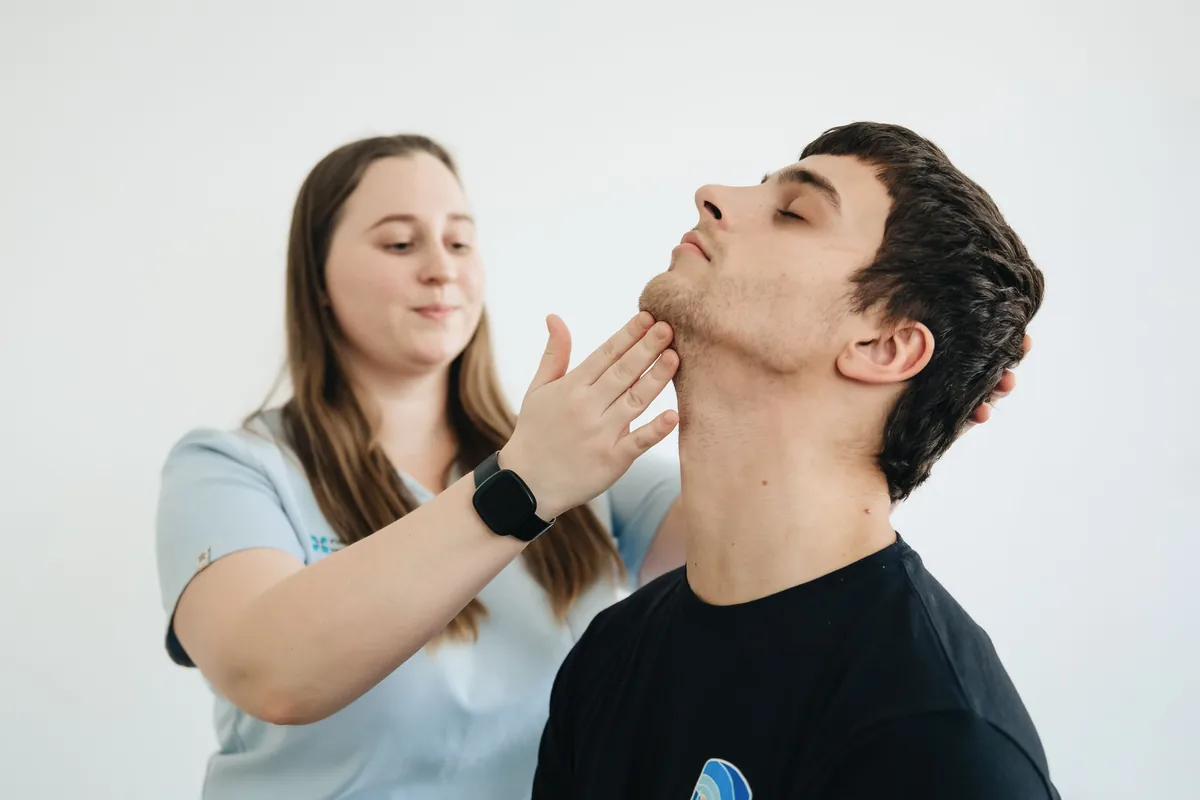
The exam includes reflex testing and strength testing, muscle by muscle. It also includes Spurling’s maneuver: we tilt and press the neck toward the painful side to see if it brings back the arm pain. A 2025 meta-analysis in the American Journal of Physical Medicine & Rehabilitation found Spurling’s test works well to rule the diagnosis in when positive. A negative test does not rule it out on its own. Sometimes the pattern is unclear. Or a trapped nerve lower down, like carpal tunnel or cubital tunnel syndrome, could explain numbness in the same fingers. Then electromyography and nerve conduction studies pin the problem to the root rather than to a nerve further down the arm. That difference changes which structure gets treated entirely.
Does a cervical epidural injection help radiculopathy?
A cervical epidural steroid injection is placed transforaminally (through the opening where the root exits) under fluoroscopic guidance (live X-ray) at the confirmed level. It quiets the inflammatory part around the root. A 2020 systematic review and meta-analysis in Pain Medicine looked at fluoroscopically guided cervical transforaminal injections for radicular pain (pain that travels down the arm). It found meaningful pain reduction. That fits the same window-not-repair logic used everywhere else on this site. The injection does not open up the foramen. It buys the time in which inflammation settles and, in many cases, the disc material resorbs (is taken back up by the body).
The terrain underneath it
Posture is only part of the story. Systemic inflammation and insulin resistance raise the baseline that the nerve root’s own chemical irritation builds on. They also slow the recovery of the small vessels the nerve depends on. That is why bloodwork is part of the plan alongside the injection. So is the behavioral piece of this practice’s protocol, delivered in-house through Acceptance and Commitment Therapy. Sleep, movement and behavior covers how posture, screen habits and sleep position are handled directly.
When does cervical radiculopathy need surgery?
For most cervical radiculopathy, surgery is not part of the plan. A 2013 systematic review in the European Spine Journal compared surgical to conservative care for neck pain. It found outcomes converge over time for many patients. That favors a conservative and interventional trial first, where it is safe to give one. What changes the math is a motor deficit (lost muscle strength) that is new or getting worse, because nerve function lost to ongoing compression does not reliably return once decompressed later. That means a triceps or hand grip getting measurably weaker over days to weeks, not just pain that is severe. When that is the picture, or when conservative and interventional options have run out without resolution, this practice sets up the surgical conversation directly. We do not leave a patient to find their own way there.
What happens at the visit and on the day of a cervical epidural?
The first visit is the map. We test each arm muscle against resistance, check reflexes and sensation finger by finger, and write down the numbers, because the same tests are repeated later to tell whether a weak muscle is recovering or slipping. Bring any neck imaging and the names of every medicine you take, including blood thinners.
On the injection day you lie face down and stay awake under local anesthetic; there is no sedation. Live X-ray guides the needle to the level the exam found. Most people drive themselves home and are back to normal activity, including work, within two to four hours. If the arm feels numb or weak, have someone else drive until it passes. The weeks that follow are for gentle nerve-gliding work and fixing the screen and sleep positions that keep pressing on the root, while the steroid calms it.
Red flags, in plain terms
GET SEEN URGENTLY
- An arm or hand getting weaker over days, not just staying painful.
- Trouble with balance, fine hand coordination, or a change in bladder or bowel control along with neck pain. This suggests the spinal cord itself, not just a root.
- Neck pain with fever, or that began after a significant fall or collision.
Read the full list on when it is an emergency.
Frequently asked questions
Do I need a referral for a pinched nerve in my neck?
No. You can schedule directly for arm pain or numbness from the neck. Some insurance plans want a referral on file before they cover the visit or an injection, and we check that first. Referrals and pain care explains which plans ask.
Could this be carpal tunnel instead?
Possibly. Both can numb the thumb and index finger. That is exactly why the exam checks for neck-specific findings. When it is unclear, an EMG separates a root problem from a trapped nerve at the wrist. See what to expect for how the first visit is set up.
Do I need an MRI right away?
Not always. The exam and symptom map often pin down the level with enough confidence to start treatment. Imaging is saved for cases that are unclear or not improving, much like the approach on sciatica.
Will a cervical epidural help my neck pain or just my arm?
It is aimed at the nerve root, so it mainly targets the arm pain and the neurological symptoms. Neck pain alone, with no arm pain, is more often a facet joint question.
How long until I know if treatment is working?
Local anesthetic effect shows within the hour. The steroid effect builds over several days. We typically recheck at two weeks, the same interval used across epidural steroid injection in general.
Is surgery ever the first step?
Rarely, and only with a progressive motor deficit or spinal cord involvement. Otherwise, conservative and interventional care are tried first. That decision point is also covered on when injections stop working.
What flares up cervical radiculopathy?
Two things do most of the work: pressure on the nerve root and inflammation from leaked disc material. Hours spent with your neck bent forward over a phone or a low screen narrow the openings where the roots exit. That adds load to a nerve that is already inflamed. Systemic inflammation and insulin resistance raise the baseline that irritation builds on. They also slow recovery.
How long does cervical radiculopathy take to get better?
Many patients improve without surgery as the inflammation around the root settles. In many cases, the disc material also resorbs. After a cervical epidural, the numbing medicine works within the hour, the steroid builds over several days, and we recheck at two weeks. An arm or hand that keeps getting weaker changes the timeline and needs to be seen urgently.
What should I avoid with a pinched nerve in my neck?
Avoid long stretches with your neck bent forward over a phone or a low screen, because that posture narrows the same openings the nerve passes through. Do not wait out an arm or grip that is getting weaker. Do not wait out new trouble with balance or hand coordination, or any change in bladder or bowel control. Those need urgent evaluation, not more time.
Related reading
- Epidural steroid injection
- Facet joint pain
- Occipital neuralgia
- After a car accident
- Sciatica
- Shoulder arthritis
Sources
- Yousif MS et al. Neurological examination for cervical radiculopathy: a scoping review. BMC Musculoskeletal Disorders, 2025. PubMed 40188056
- Lin LH et al. Diagnostic Performance of Spurling’s Test for the Assessment Subacute and Chronic Cervical Radiculopathy: A Systematic Review and Meta-analysis. American Journal of Physical Medicine & Rehabilitation, 2025. PubMed 39938056
- Conger A et al. The Effectiveness of Fluoroscopically Guided Cervical Transforaminal Epidural Steroid Injection for the Treatment of Radicular Pain; a Systematic Review and Meta-analysis. Pain Medicine, 2020. PubMed 31181148
- van Middelkoop M et al. Surgery versus conservative care for neck pain: a systematic review. European Spine Journal, 2013. PubMed 23104514
We will tell you which root we think is involved before we treat it
The map of your symptoms tells us where to look first, and we will show our reasoning before any needle is near your neck.
4479 Woodson Rd, Suite 401
St. Louis, MO 63134
Next to St. Louis Lambert International Airport, off I-70 at Woodson Road.