Sympathetic nerve block · St. Louis
A drooping eyelid after a sympathetic nerve block is not a complication. It is proof the medication reached the right nerve.
A sympathetic nerve block numbs the chain of nerves that controls blood flow, sweating and blood vessel tone in a limb. It does not target the nerves that carry pain directly. It tests whether your own sympathetic nervous system is part of the problem.
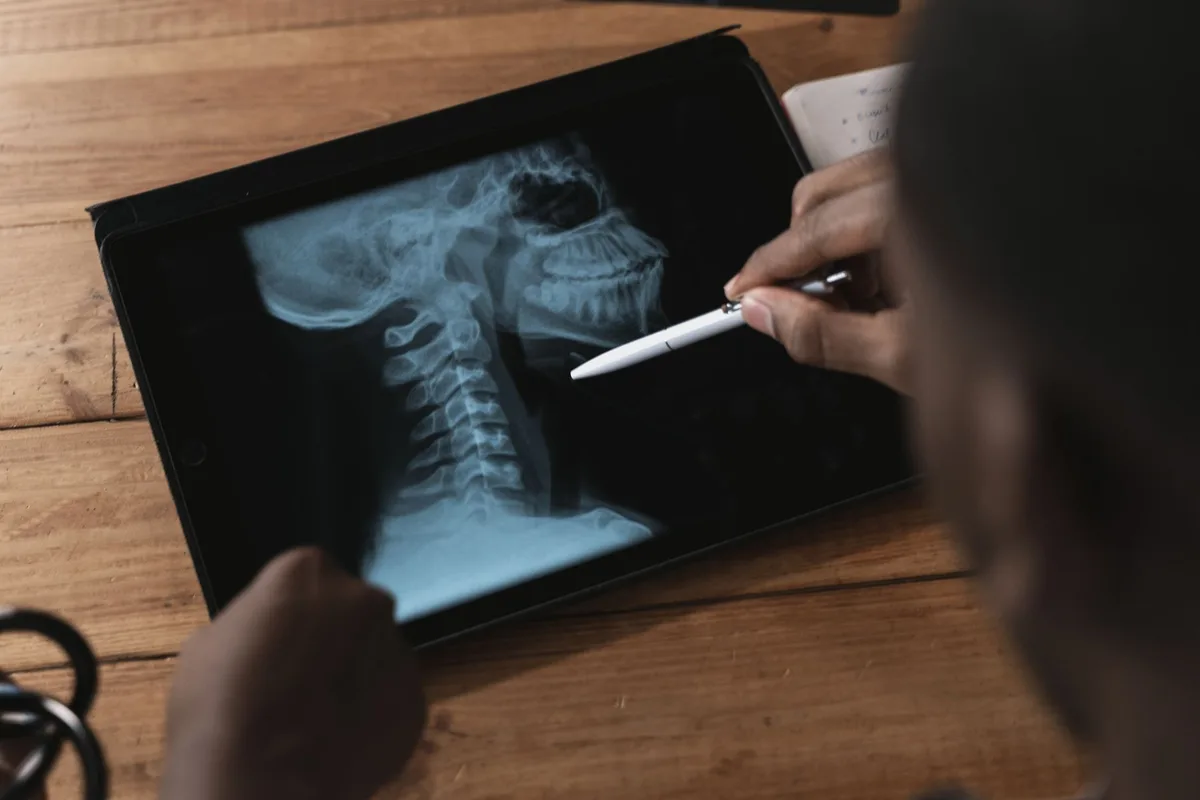
What does a sympathetic nerve block treat?
The sympathetic nervous system runs a chain of ganglia (nerve relay stations) along the spine. It controls how wide blood vessels open, the sweat glands and skin temperature. You never have to think about it. In most pain, that system is a bystander. In a few conditions, it is not. These include complex regional pain syndrome, some nerve injuries after trauma, and certain blood vessel pain syndromes. There, the sympathetic chain itself becomes sensitized. It starts turning pain signals up instead of just running the plumbing. A limb that is cold, discolored, sweating oddly or swollen far beyond the original injury is the picture that makes us suspect this.
A sympathetic block numbs the ganglion that serves that limb. If pain drops substantially while the block is working, the sympathetic system is at least part of what drives it. That is called sympathetically maintained pain. If the block does very little, the pain is running on its own, apart from that system. Then treatment goes a different direction entirely.
Two versions, by location
STELLATE GANGLION BLOCK
Targets the sympathetic ganglion in the neck that serves the head, neck, arm and hand. Used for CRPS or sympathetically maintained pain in the arm, some facial pain syndromes, and blood vessel conditions that affect blood flow to the hand.
LUMBAR SYMPATHETIC BLOCK
Targets the sympathetic chain along the lumbar spine that serves the leg and foot. Same logic, same patients, applied below the waist. CRPS of the leg is the most common reason we do this one.
Why does the eyelid droop after a stellate ganglion block?
A stellate ganglion block that has reached its target reliably causes a short-lived Horner’s sign on that side. You get a slightly drooping eyelid, a smaller pupil, and a dry, flushed feeling on that half of the face. It is unsettling to see in a mirror. But it is not a side effect in the sense of something going wrong. The sympathetic fibers to the eye and face go quiet along with the fibers to the arm. That is how we confirm the block reached the right spot at all. It clears as the local anesthetic wears off, usually within several hours.
What happens if a sympathetic nerve block works?
A single block is diagnostic. For some patients, a series of blocks that each give real, repeatable relief can start to become treatment in its own right. This is most true early in CRPS, when the sympathetic part often plays a bigger role than it does later in the disease. For others, a clearly positive diagnostic result makes the case for a longer-acting treatment. That means radiofrequency ablation of the sympathetic chain. In refractory cases (pain that has not responded to other care), it means a talk about spinal cord stimulation, which works on a different part of the same problem. What we do not do is repeat a block forever, hoping one more will hold where the last several did not. Shrinking returns from the same treatment are diagnostic information in themselves, and we act on them.
The terrain underneath a sensitized nervous system
Sympathetically maintained pain does not appear out of nowhere. Pain that keeps going holds the sympathetic and central nervous systems on high alert through ongoing inflammatory signaling. Poor sleep is nearly universal in CRPS, because a limb that burns at rest does not let you sleep. That poor sleep throws the autonomic nervous system further off balance. That is the same system the sympathetic block is aimed at. Now add the isolation of a discolored, swollen limb that draws stares and questions. That social cost becomes a third driver that keeps the system revved up. This practice treats the block as one piece of a plan that also addresses sleep and the nervous system’s overall arousal state, because a block placed into terrain no one is working on tends to hold for a shorter time than the same block placed into a plan that works on all three fronts.
The evidence, honestly
A 2024 systematic review and meta-analysis of stellate ganglion block for complex regional pain syndrome found meaningful short-to-medium-term pain relief across the pooled studies. The studies varied a great deal in technique, dose and how they measured results. The field has not settled on a single protocol. A 2023 study of lumbar sympathetic block in lower-extremity CRPS type 1 looked at predicting who would respond. It used an objective measure of sympathetic function, not pain reports alone, because self-reported response to a block that also numbs nearby tissue is an imperfect signal on its own. The evidence is good that the mechanism works. The evidence is weaker on exactly who benefits most and for how long. That is why we treat a positive block as one data point in a changing picture, not a single verdict. It is also why CRPS care in general is staged and rechecked, not locked in ahead of time.
What happens during a sympathetic nerve block?
- Baseline skin temperature, color and pain recorded on the affected limb.
- Positioned and skin anesthetized over the target: the front of the neck for stellate, the low back for lumbar.
- Needle advanced under live fluoroscopy or ultrasound, with contrast dye confirming it spreads to the correct layer.
- Local anesthetic delivered. We measure skin temperature on the treated side. A rise is an objective sign the block reached the sympathetic chain.
- No sedation. Observation, then most patients drive themselves home. Track pain and function over the following hours and report back.
What are the risks of a sympathetic nerve block?
A stellate block brings the expected, short-lived Horner’s sign. Beyond that, both procedures carry the general small risks of an injection near major blood vessels and nerves. These are bleeding, infection, and rarely, spread of anesthetic to a nearby structure. After a stellate block, that can cause short-lived hoarseness or a heavy feeling in the arm. Serious problems are uncommon when done under live imaging by someone who does this all the time. That is why we do not do this one blind. A lumbar sympathetic block carries a small risk of temporary leg weakness if anesthetic spreads to a nearby nerve root. It clears as the medicine wears off.
Frequently asked questions
How is this different from a stellate block for PTSD?
Same target in the body, different reason for use and different evidence base. This page covers stellate and lumbar sympathetic blocks for pain and blood vessel problems. That is the same group of patients that may also be considered for spinal cord stimulation in refractory cases.
What if the block does not help at all?
That is useful information, not a dead end. A negative sympathetic block tells us your pain runs apart from that system. We then turn toward somatic (body tissue) or central (brain and spinal cord) causes instead. See complex regional pain syndrome for how the full workup is staged.
How many blocks will I need?
There is no fixed number. The first is diagnostic. Whether a second or third is worth doing depends entirely on what the first one showed. We weigh it the same way we weigh any repeat injection. See when injections stop working.
Is CRPS the only reason to do this?
CRPS is not the only reason. Other reasonable candidates include some blood vessel conditions that affect blood flow to a hand or foot. They also include some pain syndromes after trauma or surgery that have sympathetic features, including some seen after a car accident. We evaluate them the same way.
Will my arm or leg feel numb afterward?
Usually not the way a sensory block would numb it. This targets the sympathetic fibers only. Most patients keep normal feeling and just notice warmth. With a stellate block, they also get the short-lived facial changes described above. If you also need direct pain-nerve numbing, that is a different procedure we discuss at your visit.
How long do sympathetic nerve blocks last?
The local anesthetic itself wears off within several hours, and the temporary eyelid and facial changes of a stellate block fade with it. What lasts is the answer the block gives. For some patients, especially early in CRPS, a series of blocks that each give real relief becomes treatment in its own right. A block placed inside a plan that also treats sleep and isolation tends to hold longer.
What should I do after a nerve block injection?
No sedation is used. You stay awake under local anesthetic. Most patients drive themselves home. Normal activity, including work, resumes within two to four hours. If an arm or leg feels weak or numb, have someone else drive until that wears off. After a period of observation, keep track of your pain and what you can do with the limb over the next several hours, then report back, because that record is how the block is judged. Expect warmth in the treated limb, and after a stellate block a droopy eyelid on that side that fades as the medication wears off.
What is the success rate of sympathetic nerve blocks?
There is no single number. A 2024 review of stellate ganglion block for CRPS found meaningful short-to-medium-term pain reduction across pooled studies. Technique and measurement varied widely. The evidence that the mechanism works is good. The evidence on exactly who benefits most, and for how long, is thinner. That is why a positive block is treated as one data point in a staged plan.
Related reading
- Complex regional pain syndrome
- Spinal cord stimulation
- When injections stop working
- Sleep, movement and behavior
- After a car accident
- Ketamine for CRPS
We will show you the temperature change, not just tell you about it
A successful sympathetic block is measurable, not a matter of feel. We track it objectively and tell you plainly what the numbers showed.
4479 Woodson Rd, Suite 401
St. Louis, MO 63134
Next to St. Louis Lambert International Airport, off I-70 at Woodson Road.
Sources
- Tian Y et al. Stellate Ganglion Block Therapy for Complex Regional Pain Syndrome: A Systematic Review and Meta-Analysis. Pain Physician, 2024. PubMed 38805523
- Xu Y et al. Prediction of the Efficacy of Lumbar Sympathetic Block in Patients with Lower Extremity Complex Regional Pain Syndrome Type 1 Based on the Sympathetic Skin Response. Journal of Pain Research, 2023. PubMed 37014620
- Żyluk A. Complex regional pain syndrome: observations on diagnosis, treatment and definition of a new subgroup. Journal of Hand Surgery, European Volume, 2013. PubMed 23221182