Compression fracture · St. Louis
A compression fracture is not just a broken bone. It is a report on how your bone has been metabolizing for years.
A compression fracture is the front of a vertebra collapsing under a load it could not bear. The load can be a fall or car accident, or nearly nothing, like a cough. When it happens under ordinary load, it tells you how your bone has been metabolizing. Treat only the crushed bone without reading that, and you invite the next fracture.
Bone is a living, hormonally active organ, not scaffolding.
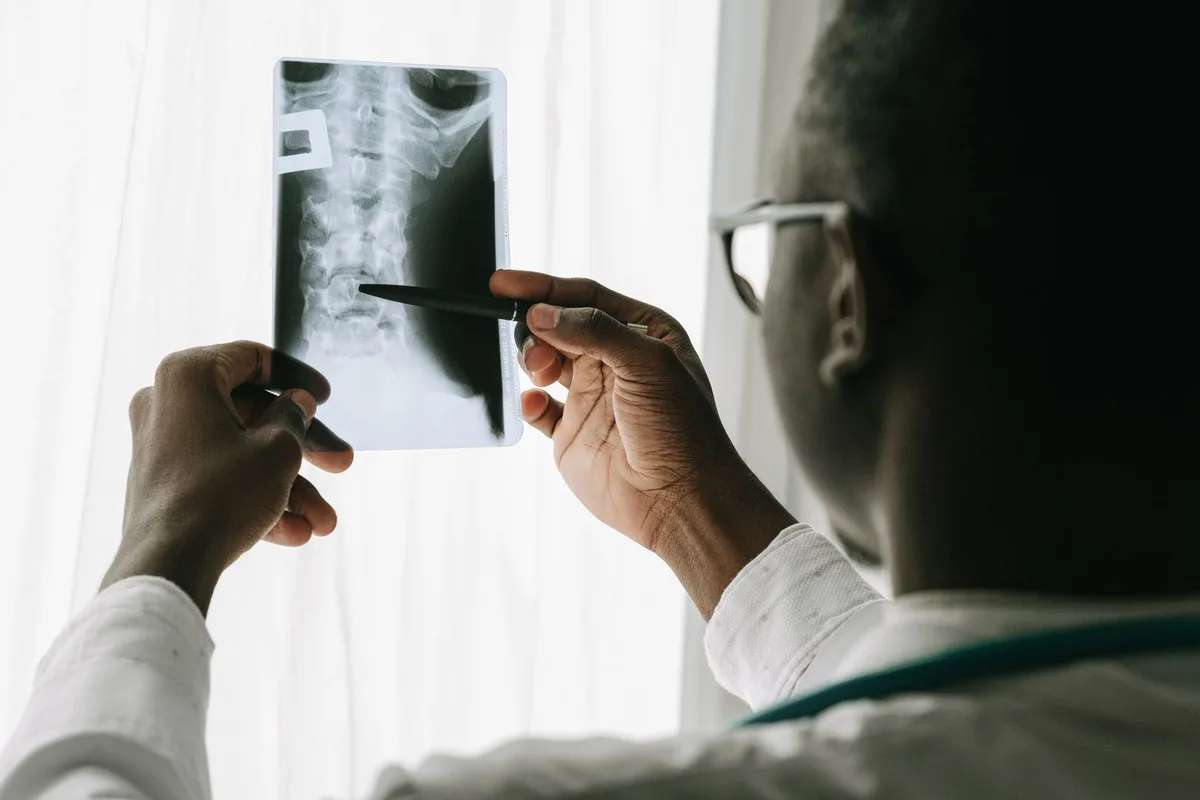
What causes a compression fracture?
A compression fracture is the front of a vertebra collapsing under a load it could not bear. Two failures usually combine to get there. The first is mechanical load. That can be huge force from a fall or car accident, or nearly nothing at all — a cough, a step off a curb. The second is a bone-remodeling imbalance. The cells that break down old bone are outpacing the cells that build new bone. So the vertebra was already weaker than its shape suggested before it ever failed. A third driver, behavior, sits under most of this group. Under-treated osteoporosis, long-term steroid use, smoking and inactivity all hold down the bone-building side of that balance. That is why the fracture threshold keeps dropping in patients who have never been screened.
What kinds of compression fractures are there?
OSTEOPOROTIC
Happens under everyday load — lifting groceries, sneezing, a minor stumble. The low force it takes is itself the diagnosis. It means the bone failed, not that the activity was dangerous. This is most of what this practice sees.
TRAUMATIC
Comes from real force — a car accident, a fall from height — in a spine that may or may not have been weak beforehand. We ask both questions at once. How hard was the impact? Was the bone already weak?
CANCER-RELATED
Metastatic disease (cancer that has spread) or myeloma can weaken a vertebra from within before any fall. Some fractures have no clear mechanical cause, especially with unexplained weight loss or a known cancer history. Those get imaging that looks for cancer first, before we assume a purely osteoporotic cause.
Bone as a metabolic organ
Bone is not a dead frame. It is rebuilt all the time. It also releases signaling proteins — osteocalcin among them — that take part in sugar and energy use elsewhere in the body. A 2024 review in the Journal of Clinical Medicine calls bone a truly neglected endocrine (hormone) organ. The talk runs both ways. The same insulin resistance and inflammation driving pain and metabolic disease in this group also degrade bone remodeling. A fracture threshold that keeps dropping is often a metabolic finding wearing an orthopedic costume. That is why a bone-health workup after a low-force fracture is not a formality — it is where the real answer usually lives.
How is a compression fracture diagnosed?
Imaging confirms the fracture and its age. Is the collapse fresh, based on bone marrow edema (extra fluid in the bone) on MRI? Or is it old and already healed, which matters because kyphoplasty helps a fresh, still-mobile fracture and does little for one that has already set. Bone density testing and basic labs look for the metabolic driver. Current guideline-based care treats osteoporosis as part of a compression fracture plan, not a separate referral to be booked someday. Sometimes the cause does not fit — small trauma in a patient without known osteoporosis risk, or an odd fracture pattern. Then imaging looks for a cancer-related cause.
How is a compression fracture treated?
Kyphoplasty restores the height of the vertebra with a balloon and holds the fracture with cement. A 2023 meta-analysis in Pain Physician found that earlier treatment — within roughly the first several weeks of a fresh, painful fracture — gives better pain relief and function than waiting. Bracing and pain control are still reasonable first steps for fractures that are bearable and improving. A real share heal well without a procedure. What we watch for is a fracture that is not settling. That means pain that stays severe past a few weeks, height loss that grows on repeat imaging, or a patient who cannot get up and move because of pain. That matters because long bed rest itself speeds up bone loss and raises the risk of the next fracture. Left untreated, an unstable fracture can keep losing height and bend the spine forward (kyphosis). That changes posture, breathing and the load on the next vertebra up the chain. Kyphoplasty is a minimally invasive procedure, not open spine surgery. It is what this practice performs for a fracture that is not settling. Open surgical stabilization is a separate and much rarer talk. It is saved for fractures causing neurological compromise (pressure on the spinal cord or nerves) or severe spinal instability, and we plan it with a spine surgeon rather than doing it here.
What happens if you need kyphoplasty, and in the weeks after?
Kyphoplasty is one of the few procedures here done with mild sedation, so you need someone to drive you. You lie face down, the fracture is reached through the back under X-ray, the balloon restores height and cement holds it. You recover on site, then go home the same day. Many patients notice the fracture pain easing quickly, because the moving bone has been stopped.
The weeks after are where the next fracture is prevented. Bone density testing and labs for vitamin D, calcium handling and the metabolic drivers are ordered if they were not done already, and treatment for the bone itself starts. Walking resumes early, because bed rest drains bone. Strength and balance work follow, because a fall on weakened bone is a common way the next fracture happens.
When is a compression fracture an emergency?
GET SEEN URGENTLY
- New numbness, weakness, or loss of bladder or bowel control — suggests the fracture is affecting the spinal canal.
- A fracture with no clear mechanical cause, unexplained weight loss, or a personal history of cancer.
- Fever, or pain that is worsening rather than gradually settling week over week.
Read the full list on when it is an emergency.
Frequently asked questions
Can I be seen for a compression fracture without a referral?
Yes. You can book directly, and fresh fractures are seen promptly because timing matters for kyphoplasty. Some insurance plans want a referral on file before they approve the procedure, so we check that in parallel. Referrals and pain management explains which plans ask.
Do all compression fractures need kyphoplasty?
Many heal well with bracing and pain control alone. The procedure is saved for fresh fractures that are not settling or where height loss is growing, covered in full on kyphoplasty.
Why does my doctor want bone density testing after a fracture?
Because the fracture itself is evidence of a bone-quality problem that will cause another fracture if untreated. That workup belongs with the fracture visit, not a separate future referral; metabolic health and pain covers the broader terrain.
How do you know if my fracture is cancer-related?
Some fractures have no clear low-force or high-force cause, or come with weight loss or a cancer history. Those get imaging aimed at ruling cancer out before we treat it as a routine osteoporotic case. We use the same red-flag rules described in when a spine finding needs urgent evaluation.
What happens if I wait too long to treat it?
An unstable fracture that is not settling can keep losing height and change your posture. Long bed rest from pain speeds up bone loss. Earlier evaluation keeps kyphoplasty on the table if it becomes the right option, as detailed on when it is an emergency.
Can this happen again at another level?
It can, especially if the underlying bone-remodeling problem is not treated. That is why osteoporosis care and the behavior pieces on sleep, movement and behavior are part of the plan alongside any procedure.
How serious is a compression fracture of the spine?
It depends on the cause and on whether the fracture settles. Many heal well with bracing and pain control. A fracture that keeps losing height can bend you forward, called kyphosis. That changes how you stand and breathe and puts more load on the next vertebra up. A fracture from a cough or a minor stumble is also a warning that the bone itself is failing.
Should I stay in bed with a compression fracture?
Not for long. Long bed rest speeds up bone loss and raises the risk of the next fracture. Bracing and pain control are reasonable first steps when the pain is bearable and improving. If pain keeps you from getting up and moving, or stays severe past a few weeks, that is one of the signs we use to consider kyphoplasty while the fracture is still fresh.
Can a compression fracture cause paralysis or nerve damage?
A fracture that reaches the spinal canal can press on the nerves there. The warning signs are new numbness, new weakness, or loss of bladder or bowel control. Any one of them means you should be seen urgently. Fractures causing that kind of pressure on the nerves, or severe spinal instability, are the uncommon cases that need open surgical stabilization. We plan that with a spine surgeon.
Related reading
- Kyphoplasty
- Metabolic health and pain
- Sleep, movement and behavior
- Spinal stenosis
- When it is an emergency
Sources
- Liu D et al. Timing of Percutaneous Balloon Kyphoplasty for Osteoporotic Vertebral Compression Fractures. Pain Physician, 2023. PubMed 37192225
- Szeliga A et al. Bone: A Neglected Endocrine Organ? Journal of Clinical Medicine, 2024. PubMed 38999458
- Imamudeen N et al. Management of Osteoporosis and Spinal Fractures: Contemporary Guidelines and Evolving Paradigms. Clinical Medicine & Research, 2022. PubMed 35478096
- Marcia S et al. Vertebral augmentation for cancer patients. The British Journal of Radiology, 2025. PubMed 40056395
We will read the bone, not just fix the shape of it
A compression fracture gets a fracture plan and a bone-quality plan, together, so the next one does not arrive at an even lower threshold.
4479 Woodson Rd, Suite 401
St. Louis, MO 63134
Next to St. Louis Lambert International Airport, off I-70 at Woodson Road.