Sacroiliac joint pain · St. Louis
Below your belt line, worse rolling over in bed, and normal on every scan you have had. That combination points to sacroiliac joint pain, below the spine.
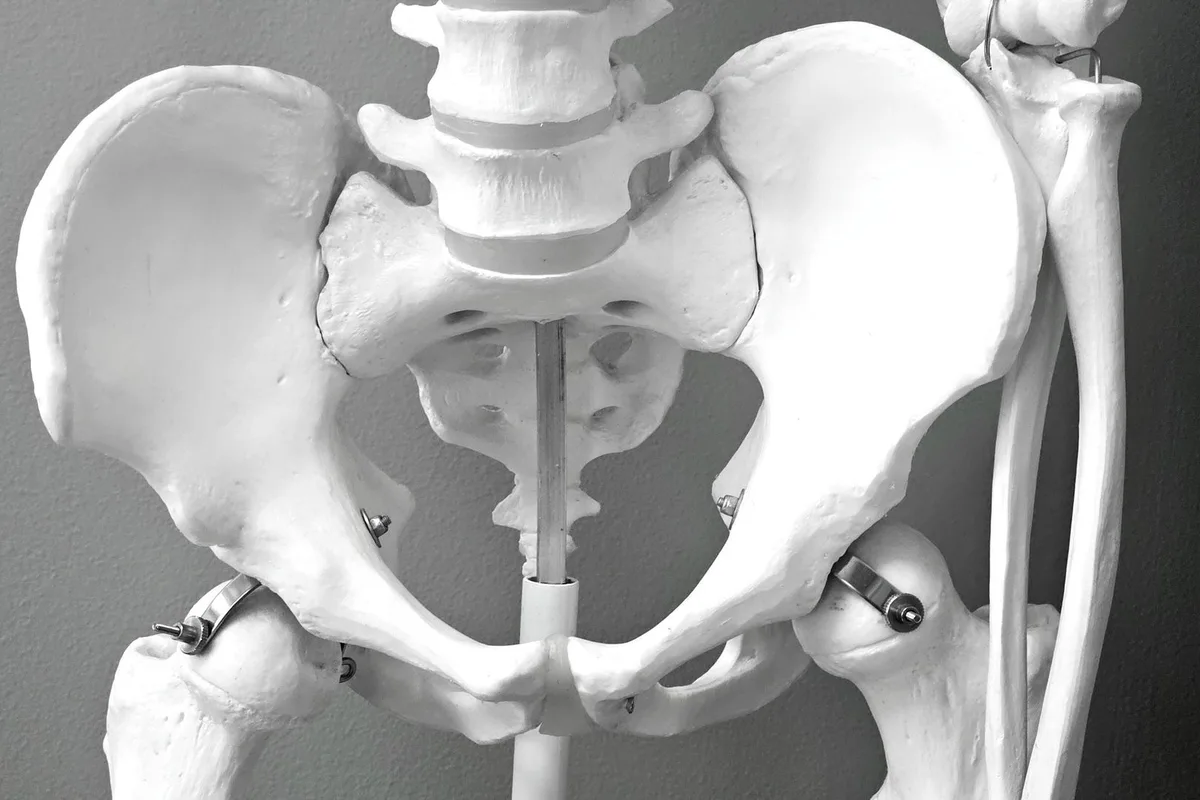
Sacroiliac joint pain comes from the joint connecting your spine to your pelvis. It is a common source of low back and buttock pain. A lumbar MRI is not built to check it, because the MRI was ordered for your spine, not your pelvis.
What causes sacroiliac joint pain?
The sacroiliac joint links the base of your spine to your pelvis on each side. It soaks up shear force every time your weight shifts from one leg to the other. Two biological problems drive most of its pain. One is mechanical strain of the ligaments that hold it steady, from a fall, a twist, or years of uneven loading. The other is a truly inflamed joint capsule, which acts like any other irritated synovial joint. A third, behavior driver is common and overlooked. Think of standing on one leg to load a car, favoring a surgical hip, or a job with lots of stair or ladder work. Each puts uneven shear through this joint day after day. That is why the pattern often builds slowly instead of showing up with one injury.
What does sacroiliac joint pain feel like?
Sacroiliac pain sits low, over the dimples just above the buttock on one or both sides. It can spread into the groin or down the back of the thigh, sometimes past the knee. That is why it is often mistaken for sciatica. The clue that sets it apart is behavior, not anatomy. The pain is sharply worse rolling over in bed, standing up from sitting, or getting out of a low car. And you can point to it with one finger instead of sweeping a hand across your whole low back. Lumbar spine pain rarely does either of those two things this clearly.
Who this shows up in
POSTPARTUM
Pregnancy hormones loosen the pelvic ligaments to get ready for birth. A 2025 prospective cohort study tracked these hormone and nerve-and-muscle changes through pregnancy. It found the resulting joint looseness tracks with clinical pelvic pain. Most looseness clears up after delivery. But some patients are left with a joint that stayed unstable past that window.
POST-FUSION
A lumbar fusion moves the motion it removed onto the segments below it. The sacroiliac joint often soaks up that extra load. New low back pain after a fusion that “worked” is often this joint, not a failure of the hardware. It deserves its own exam, not an assumption that the fusion is the problem.
And the pelvis in a car accident: a side-impact or rear-end crash loads the sacroiliac joints directly through the seat and seatbelt. We see it often along the Woodson corridor after a crash on I-70. The pain gets blamed entirely on the lumbar spine because that is what the first imaging aimed at. The joint below it was never examined.
How is sacroiliac joint pain diagnosed?
No single physical exam test is reliable alone. But grouping several together works meaningfully better: compression, distraction, thigh thrust and a few others. A 2021 systematic review and meta-analysis in the Journal of Orthopaedic & Sports Physical Therapy looked at this. It found that a positive cluster of three or more provocation tests has real diagnostic value. Any single test used alone does not. That is why the exam here is a set, not one test. And it is why a positive cluster earns a confirmatory injection, not a diagnosis on its own.
A cluster of three or more positive provocation tests, not any single test alone, is what makes the sacroiliac joint a credible suspect.
Confirming it with an image-guided injection
The joint sits deep and its surface is uneven, so it cannot be reached reliably by feel. A sacroiliac joint injection is placed under fluoroscopic or ultrasound guidance. Contrast dye confirms the needle is truly inside the joint before medication is given. It is both the diagnostic step and, often, an early therapeutic one. A 2025 multispecialty consensus guideline covers sacroiliac joint complex pain. It lists image-guided intra-articular injection as the standard confirmatory test. That holds once a provocation cluster and your history point here.
How is sacroiliac joint pain treated for the long term?
For a confirmed joint, cooled radiofrequency ablation of the lateral branch nerves supplying it can hold relief for many months at a time. A 2024 multicenter randomized comparative-effectiveness trial in Regional Anesthesia and Pain Medicine tested it. It found cooled RFA meaningfully beat standard medical management for chronic sacroiliac joint pain. That is our evidence base. We use it when we move a confirmed patient from injection to radiofrequency ablation rather than repeating injections forever.
Do you need surgery for sacroiliac joint pain?
For confirmed sacroiliac joint pain, surgery is not part of the treatment plan we build. Image-guided injection and lateral branch radiofrequency ablation are the interventional path offered here. Most confirmed patients get lasting relief from that path without ever needing an operation. Sacroiliac joint fusion exists. It is right for some patients whose pain keeps returning despite repeated, successful radiofrequency treatment. In that case, it is a conversation for a surgical partner, coordinated from here. It is not a procedure done in this office.
Red flags, in plain terms
GET SEEN URGENTLY
- Pelvic or low back pain following a high-force collision or fall, especially if you cannot bear weight on one leg.
- Fever, or pain out of proportion after any recent joint injection or procedure in the area.
- New numbness across the saddle area or loss of bladder or bowel control.
Read the full list on when it is an emergency.
Frequently asked questions
Do I need a referral to be checked for sacroiliac joint pain?
No. You can book the evaluation yourself. Some plans want a referral on file before they pay for the visit or the diagnostic injection, so we check your coverage first. Do you need a referral for pain management? explains which plans ask for one.
How is this different from sciatica?
Sacroiliac pain sits lower, and you can point to it with one finger over the joint. It gets worse with specific movements like rolling in bed. By contrast, sciatica follows a nerve root path with a matching exam finding.
Can pregnancy cause permanent sacroiliac pain?
Usually the ligament looseness clears up after delivery. But a minority of patients still have symptoms and benefit from the same workup covered here and on what to expect.
I had a fusion and now my hip area hurts. Is the hardware failing?
Often not. New pain below a working fusion is often the sacroiliac joint soaking up the shifted load. That is worth confirming before assuming a hardware problem; see failed back surgery syndrome.
Why does the injection need imaging guidance?
The joint sits deep with an uneven surface that cannot be found reliably by feel. So contrast confirms the needle is truly inside it before medication is given. The full procedure is on sacroiliac joint injection.
Will I need this treated again?
Radiofrequency relief is lasting but not permanent, since treated nerves grow back. When it fades, re-treating the same confirmed joint is typical, a pattern covered on when injections stop working.
What is the one finger test for sacroiliac joint pain?
It is a clue from your own pointing. Sacroiliac pain tends to sit in one spot you can point to with one finger, over the dimple just above the buttock. You do not sweep a hand across your whole low back. Add pain that is sharply worse rolling over in bed, standing up from sitting or getting out of a low car. Together, that points to the joint, not the lumbar spine.
How do you cure sacroiliac joint pain?
First, confirm the joint is the source. That takes a cluster of provocation tests, then an image-guided injection that doubles as early treatment. For a confirmed joint, cooled radiofrequency ablation of the lateral branch nerves can hold relief for many months at a time. That relief is lasting but not permanent, because treated nerves grow back. Re-treating the same joint is typical.
What makes sacroiliac joint pain worse?
Uneven loading. Standing on one leg to load a car, favoring a surgical hip, and jobs with repeated stair or ladder work all push shear through the joint day after day. Rolling over in bed, standing up from sitting and getting out of a low car usually make the pain sharply worse. That is also how the joint gives itself away.
When is sacroiliac joint pain an emergency?
Get seen urgently for pelvic or low back pain after a high-force collision or fall, especially if you cannot bear weight on one leg. The same goes for fever, or pain out of proportion, after a recent injection or procedure in the area, and for new numbness across the saddle area or any loss of bladder or bowel control.
Related reading
- Sacroiliac joint injection
- Radiofrequency ablation
- Sciatica
- Failed back surgery syndrome
- After a car accident
Sources
- Saueressig T et al. Diagnostic Accuracy of Clusters of Pain Provocation Tests for Detecting Sacroiliac Joint Pain: Systematic Review With Meta-analysis. Journal of Orthopaedic & Sports Physical Therapy, 2021. PubMed 34210160
- McCormick ZL et al. Consensus practice guidelines on sacroiliac joint complex pain from a multispecialty, international working group. Pain Medicine, 2025. PubMed 41318933
- Cohen SP et al. Cooled radiofrequency ablation versus standard medical management for chronic sacroiliac joint pain: a multicenter, randomized comparative effectiveness study. Regional Anesthesia and Pain Medicine, 2024. PubMed 37407279
- Daneau C et al. Changes in pregnancy-related hormones, neuromechanical adaptations and clinical pain status throughout pregnancy: A prospective cohort study. PLoS One, 2025. PubMed 39982927
We test the joint below the belt line before we assume it is your spine
A cluster of provocation tests, and where they point here, a guided injection to confirm it — before any procedure is planned.
4479 Woodson Rd, Suite 401
St. Louis, MO 63134
Next to St. Louis Lambert International Airport, off I-70 at Woodson Road.