Facet joint pain · St. Louis
Facet joint pain gets treated as a disc problem for years, because the joint that is actually hurting never shows up on the scan that found the disc.
Facet joint pain comes from the small paired joints at the back of each vertebra. It usually starts in an inflamed joint capsule, and it gets worse when you lean back or twist. An MRI shows arthritis in these joints. It cannot tell whether a given joint is the one making your pain. So we confirm the source with two diagnostic medial branch blocks.
The small joints that let your spine bend and twist do not light up on a standard MRI the way a disc does. So pain from them is routinely blamed on whatever the scan did find. There is a specific way to test that guess.
What causes facet joint pain?
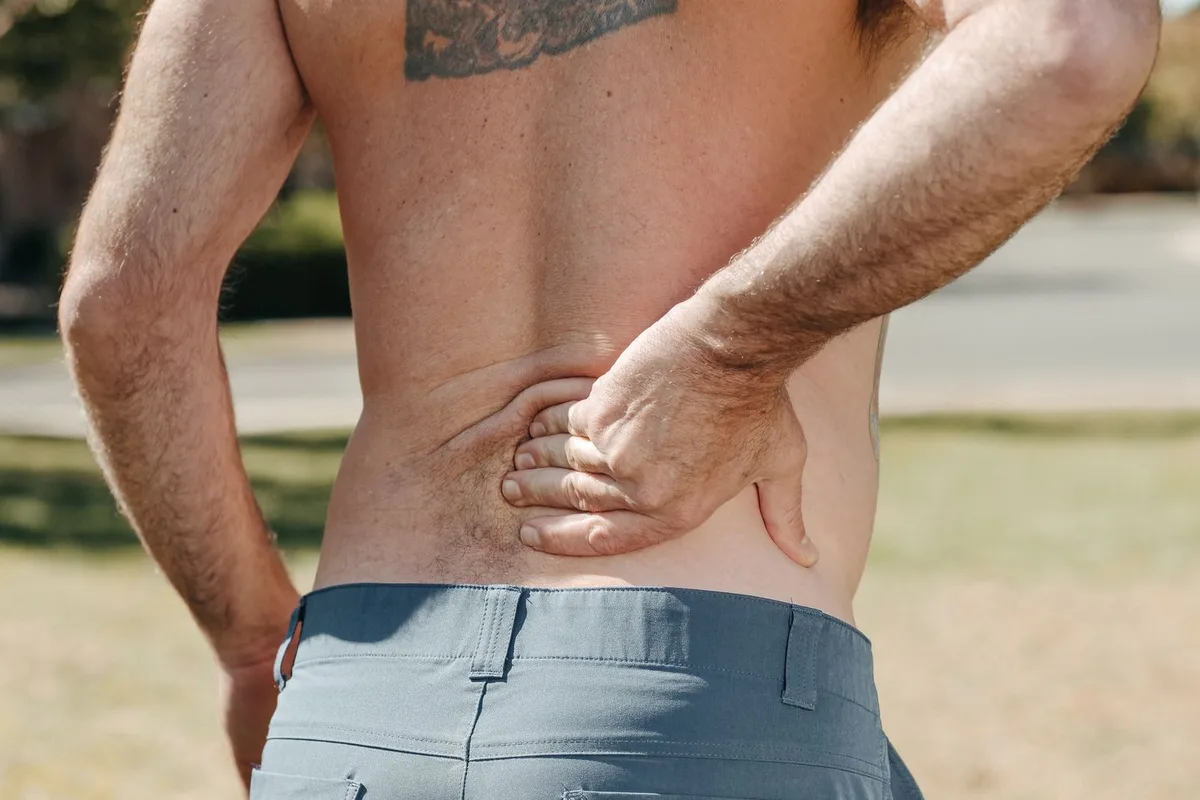
Facet joints are the small paired joints at the back of each vertebra. They let your spine lean back, turn and bend to the side. Like any joint, they can develop arthritic change and a swollen, irritated capsule. A 2022 review in the Korean Journal of Pain points to that capsular inflammation, not the arthritis itself, as the real source of the ache. That is why two spines with similar arthritic wear on imaging can hurt very differently. Postures that load the spine backward press these joints directly. Think of leaning back to see a screen mounted too high. Or any job that holds the neck or low back bent backward for long stretches. That drives repeated load into the exact joint that is already inflamed. Pain gets worse with leaning back and turning, and eases with bending forward. That is the reverse of a disc problem.
Why doesn’t facet joint pain show up on an MRI?
An MRI is good at showing arthritic change in a facet joint. It is not good at telling you whether that joint is the one making your pain. The reason is that facet arthritis is common in spines with no pain, and how bad it looks on imaging matches symptoms poorly. So the disc or arthritis the report flags becomes the working diagnosis by default. Treatment gets aimed there, and it does not help. The reason is not that the treatment was wrong. It is that the target was never confirmed.
How is facet joint pain diagnosed?
Each facet joint is fed by small sensory nerves called medial branches. We numb the medial branches feeding a suspected joint, under fluoroscopic guidance (live X-ray). That is the only reliable way to confirm that joint as the source. If your usual pain goes away while that nerve is numb, that points to the joint it serves as the source. A single block gives useful data. But placebo response and false positives happen. So a second, confirmatory block on a separate day is the standard we follow. Only then do we recommend a permanent nerve treatment based on the result.
- Exam confirms the pattern — pain set off by leaning back and turning, without pain shooting down a leg or arm.
- First diagnostic medial branch block, a small volume of local anesthetic placed at the suspected level under fluoroscopy.
- You track relief over the next several hours against your usual pain, on a simple log.
- A second confirmatory block on a separate day, because one positive response alone is not enough to commit a patient to a permanent nerve procedure.
- Two concordant positive responses make the joint a confirmed target for a lasting procedure.
Can whiplash cause facet joint pain?
After a rear-end crash, the cervical facet joints are a leading source of the neck pain that follows. That is true even when imaging looks normal. A 2025 review in Pain Practice on whiplash-associated disorder looks at injury to the capsule of these joints. It happens during the whip-like back-and-forth motion of a crash. The review names it a primary driver of chronic neck pain after a crash. It is separate from any disc or ligament injury the first workup focused on, and often missed next to it. That is the exact group we see along the airport corridor after a crash on I-70: a normal-looking scan and a joint that was never tested.
What is the longest-lasting treatment for facet joint pain?
Once medial branch blocks have confirmed a joint, radiofrequency ablation heats the same nerves to interrupt the pain signal for months at a time, not hours. A 2024 meta-analysis of placebo-controlled trials in La Radiologia Medica confirmed real, lasting benefit for confirmed lumbar facet pain specifically. It did not confirm it for back pain in general. That is exactly why the confirmation step is not optional. The nerve grows back in time, so relief is not permanent. But it is the most lasting answer we have for pain that a scan alone could never have found.
When surgery is not part of the plan
Say confirmed facet pain has no instability, nerve compression or structural deformity driving it. In that case, surgery is not part of the plan. Medial branch blocks and radiofrequency ablation are the final interventional answer. Fusion is not indicated to treat facet pain by itself. That changes only if imaging and exam together show a separate structural problem, such as spondylolisthesis with instability. That is a different diagnosis entirely and would be its own conversation.
What is the day of a medial branch block like?
You lie face down while live X-ray guides a thin needle to each nerve being tested, usually two or three levels. Local anesthetic numbs the skin. You stay awake, there is no sedation, and that matters: the test depends on you reporting your own pain afterward, clearly.
Then comes the part patients do not expect. You go home and try to provoke your pain: lean back, twist, stand at the counter, sit in the car. You score it on the log every hour or so while the numbing medicine works. Most people drive themselves home and return to normal activity, including work, within two to four hours. The second block is on another day; a matching answer both times is what makes the result trustworthy.
After radiofrequency ablation, the months when the nerve is quiet are the window for strengthening the deep back or neck muscles that guard those joints. Relief without that work tends to end when the nerve grows back.
Red flags, in plain terms
GET SEEN URGENTLY
- Neck or back pain with numbness, weakness or a change in coordination in an arm or leg — suggests a nerve, not a facet joint.
- Facet-pattern pain that started with a high-force collision or fall, especially with fever or unexplained weight loss.
- New difficulty with balance or fine hand movements after a neck injury.
Read the full list on when it is an emergency.
Frequently asked questions
Can I book for facet joint pain without a referral?
Yes. No referral is needed to be evaluated here. Some insurance plans require one on file before they approve diagnostic blocks, and we confirm that before the procedure is scheduled. Referrals and pain management explains which plans ask.
How is this different from a disc problem?
Facet pain gets worse with leaning back and turning and eases with bending forward. That is the reverse of most disc-driven pain. And unlike herniated disc pain, it usually stays local instead of running down a nerve path.
Why do I need two injections before treatment?
A single block can be a false positive. A second, matching response on a separate day confirms the joint before committing to radiofrequency ablation, which is a bigger step than a diagnostic block.
How long does relief from RFA last?
Often six months to over a year, because the treated nerve grows back in time. When relief fades, the same confirmed joint is usually treated again instead of restarting the workup. This is detailed on radiofrequency ablation.
Can whiplash cause this months later?
Cervical facet capsule injury from a crash often shows up as a slow-building or delayed pattern, not instant pain. That is covered on after a car accident.
Will I need surgery?
Not for confirmed facet pain alone. Surgery matters only if a separate structural finding, like instability, is also present. That difference is covered on when injections stop working.
What are the symptoms of facet joint pain?
Facet pain usually stays in the neck or low back instead of running down an arm or leg. It gets worse when you lean back or twist, and it eases when you bend forward. That is the reverse of most disc pain. Numbness, weakness or a change in coordination in an arm or leg points to a nerve instead. That needs to be seen urgently.
What should I avoid with facet joint pain?
Cut down on postures that hold your neck or low back bent backward for long periods. Leaning back to see a screen mounted too high presses directly on the joint that is already inflamed. So does a job that keeps your spine bent backward for long stretches. Bending forward usually eases facet pain. That is one of the clues that points to these joints.
Will facet joint pain ever go away?
It can be controlled for long stretches. Once two blocks confirm the joint, radiofrequency ablation interrupts its pain signal for months at a time. The treated nerve grows back in time, so the relief is not permanent. When it fades, the same confirmed joint is usually treated again instead of restarting the whole workup.
Related reading
- Medial branch block
- Radiofrequency ablation
- Sacroiliac joint pain
- After a car accident
- Herniated disc
Sources
- Cohen SP et al. Consensus practice guidelines on interventions for lumbar facet joint pain from a multispecialty, international working group. Regional Anesthesia and Pain Medicine, 2020. PubMed 32245841
- Hurley RW et al. Consensus practice guidelines on interventions for cervical spine (facet) joint pain from a multispecialty international working group. Regional Anesthesia and Pain Medicine, 2022. PubMed 34764220
- Hellinga MD et al. 7. Cervical facet pain: Degenerative alterations and whiplash-associated disorder. Pain Practice, 2025. PubMed 39846460
- Láinez Ramos-Bossini AJ et al. Efficacy of radiofrequency in lumbar facet joint pain: a systematic review and meta-analysis of placebo-controlled randomized controlled trials. La Radiologia Medica, 2024. PubMed 38512629
We confirm the joint before we treat it permanently
Two concordant blocks, not one hopeful injection, are what earn a joint a durable procedure here.
4479 Woodson Rd, Suite 401
St. Louis, MO 63134
Next to St. Louis Lambert International Airport, off I-70 at Woodson Road.