Epidural steroid injection · St. Louis
Three levels look bad on your MRI. One epidural steroid injection tells you which one is actually the problem.
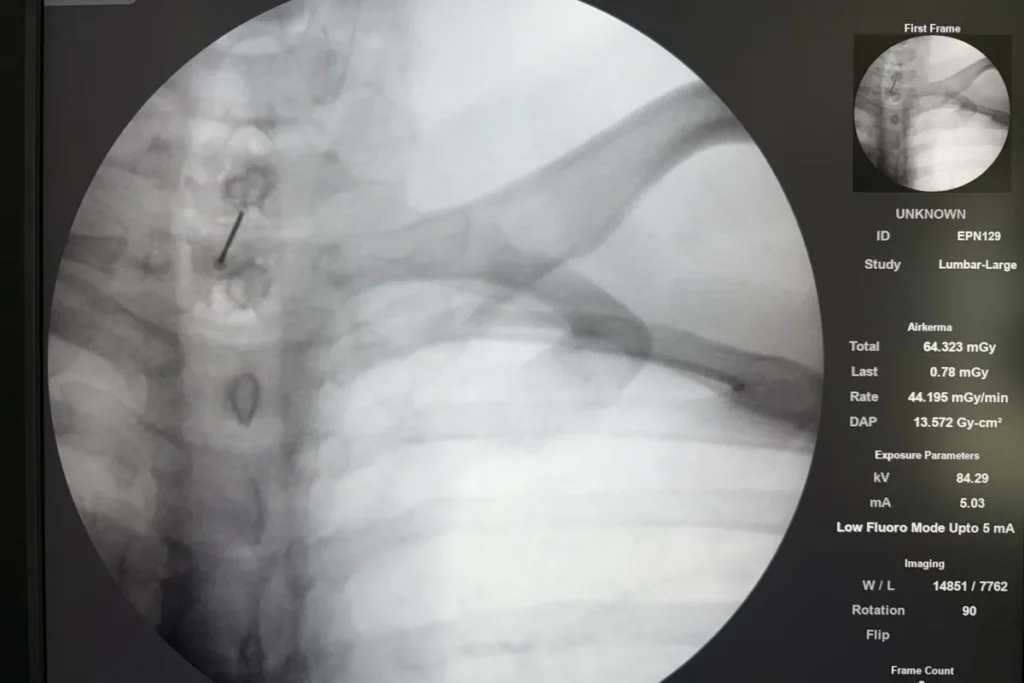
An epidural steroid injection places corticosteroid around an irritated nerve root under fluoroscopic guidance (live X-ray). When your scan shows more than one candidate level, the same injection becomes the test. It tells you which one is actually driving the pain.
How does an epidural steroid injection work?
Radicular pain — pain that runs down an arm or leg in a line, rather than sitting in the back or neck — comes from a nerve root that is both pinched and chemically inflamed. Disc material that has broken through its outer wall carries proteins and enzymes the root has never met. The body’s immune response to them is a large part of why the leg hurts more than the anatomy alone predicts. Steroid placed at that root interrupts the inflammatory signals directly.
Most extruded (pushed-out) disc material is reabsorbed by the body on its own, over weeks, with no procedure at all. What the injection changes is whether you can function through those weeks — work a shift, sleep through the night, walk the dog — while that reabsorption runs its course underneath you. The steroid never touched the disc. It touched the inflammation the disc was causing. That is a different and smaller claim than people are usually given.
What are the types of epidural steroid injection?
TRANSFORAMINAL
The needle goes to the foramen (the opening where the specific root exits), right at the source. Because the medicine lands in one exact spot, a strong response points to that exact level. That makes this route as diagnostic as it is a treatment. It is the default when one root is the suspect.
INTERLAMINAR
The needle enters between two laminae (the bony plates at the back of the spine) into a wider epidural space. The medicine spreads across levels rather than staying at one. This route fits symptoms on both sides, or a pattern that will not settle on a single level. It is worse at answering which level is to blame, because it never isolated one.
CAUDAL
The needle goes in through the sacral hiatus, a small opening at the base of the spine. The volume of fluid is relied on to travel upward to the target. This is the route of choice in a spine that has already had surgery, where scar tissue makes the other two approaches unreliable. It is also the least specific of the three for diagnosis.
Every route is done under live fluoroscopy. Contrast dye goes in first and is watched on screen before any medicine follows it. That confirms the drug is going into the epidural space and not into a blood vessel. A needle cannot feel that difference on its own, no matter how skilled the hands holding it.
The MRI does not get a single vote
Many of the lumbar and cervical MRIs that land on this desk show degeneration (breaking down) at two or three levels at once — a disc bulge, mild foraminal narrowing, an old annular tear one level above the one that is actually screaming. Age does that to spines in general, painful or not. So the scan alone often cannot say which level is causing your pain today.
A transforaminal injection placed at the one level the exam points to answers that question. The picture cannot. Relief that tracks the anesthetic — starting within the hour, wearing off on schedule — confirms that level was the source. No relief at all tells you just as much. It says look elsewhere. It also keeps a surgeon from operating on a level that was never guilty. Used this way, before a surgery talk or before picking a level, the injection does diagnostic work an MRI by itself cannot.
Does an epidural steroid injection raise blood sugar?
Corticosteroid is a whole-body drug given in one spot, and it does not stay put. It raises blood glucose for several days afterward, enough to matter in a diabetic patient. Two things work against you at once. First, the steroid pushes up the liver’s sugar output for most of a week. Second, you may already carry the metabolic inflammation and insulin resistance common in this population. If so, the tiny blood vessels the nerve root needs to heal were already weakened before the needle went in. A patient juggling a job and a flare of leg pain often has no time to check glucose four times a day that week. The rise goes unnoticed until it is a problem instead of a data point.
For years this practice sent diabetic patients home after an epidural with a generic instruction to “watch your sugar.” That was not specific enough to be useful, and it changed. If you are diabetic, tell us before the injection so the dose and the plan account for it. Expect a written window — how many days, what number should trigger a call — not a vague warning on your way out the door.
When is an epidural steroid injection the wrong choice?
Axial pain — pain across the low back or neck that does not travel down a limb — is not what an epidural answers. If nothing runs down your arm or leg, the more likely sources are the facet joints or the sacroiliac joint, each with its own diagnostic block. A good share of epidurals that disappoint were aimed at axial pain to begin with.
It is also not the tool for weakness that is getting worse. A foot drop that is getting worse week to week is on a surgical timeline, not an injection timeline. That talk happens fast, not after a trial of injections.
What happens during an epidural steroid injection?
- Symptom map recorded first, including exactly where the pain runs and where it stops. That detail later confirms whether the right level was hit.
- Positioned face down, skin cleaned and numbed.
- Needle guided to the target under live fluoroscopy, then contrast injected and watched on screen before any medication follows.
- Steroid delivered, needle withdrawn. The procedure itself takes a few minutes.
- No sedation. Short observation, then most patients drive themselves home. Track the pain over the next two weeks. The early relief from local anesthetic and the later relief from steroid are two separate clues, and both matter.
Frequently asked questions
Why not just wait it out instead?
Waiting is often reasonable early on, and plenty of sciatica clears up on its own timeline without any procedure. The injection earns its place when the pain is bad enough to cost you sleep, work or the ability to move. Then the cost of waiting outweighs the modest risk of a steroid dose.
How do I know if it actually worked?
Local anesthetic gives a window of relief within the hour that then wears off. That early response confirms the medicine reached the target, the same diagnostic logic used to confirm a level with a medial branch block. The steroid effect builds over the next few days and is checked again at the two-week mark. That is also when we decide whether we found the right level.
How many injections will I need?
There is no set number and no standing course booked in advance here. Each injection is weighed against what the last one did. If the pattern of relief and return stops making sense, that is a signal to look at why injections stop working rather than simply repeating one.
Is it safe if I have diabetes?
It can be done safely, but it needs to be planned for, not discovered afterward. Tell us in advance so dosing and monitoring account for it. The glucose response also sits on top of the wider link between metabolic health and pain that this practice treats as part of the same problem, not a separate one.
Will this complicate a future surgery?
Rarely. Surgeons often ask for a gap of a few weeks between a steroid injection and an operation at the same level, and we plan around that. If surgery is already part of the talk, as it often is for advanced spinal stenosis, telling us your surgery timeline lets us plan together rather than work around it after the fact.
Does an epidural steroid injection fix a herniated disc?
No. The steroid never touches the disc. It calms the inflammation the disc material is causing at the nerve root. Most extruded disc material is reabsorbed by the body on its own over weeks, with no procedure at all. What the injection changes is whether you can work a shift, sleep through the night and move while that healing runs its course.
How long does an epidural steroid injection take?
The injection itself takes a few minutes. Before it, we record exactly where your pain runs and where it stops, position you face down, and clean and numb the skin. The needle is guided under live X-ray and checked with contrast dye before any medication goes in. No sedation is used. You stay awake under local anesthetic. After a short observation period, most patients drive themselves home. Normal activity, including work, resumes within two to four hours. If an arm or leg feels weak or numb, have someone else drive until that wears off.
What should I do after an epidural steroid injection?
Most patients drive themselves home. If an arm or leg feels weak or numb, have someone else drive until that wears off. Track your pain over the next two weeks. Early relief within the hour comes from the numbing medicine. Later relief comes from the steroid. Both tell us something. If you have diabetes, follow the written plan you are given for checking your blood sugar, including the number that should trigger a call to us.
Related reading
We will tell you which level we are treating, and why, before we treat it
If your imaging names more than one candidate, we will explain how the injection helps sort that out and what a positive or negative response will mean for your plan — not just for the level, for the whole decision.
4479 Woodson Rd, Suite 401
St. Louis, MO 63134
Next to St. Louis Lambert International Airport, off I-70 at Woodson Road.
Sources
- Mahmoud AM et al. A systematic review and network meta-analysis comparing different epidural steroid injection approaches. Pain Practice, 2024. PubMed 37700550
- Armon C et al. Epidural Steroids for Cervical and Lumbar Radicular Pain and Spinal Stenosis Systematic Review Summary: Report of the AAN Guidelines Subcommittee. Neurology, 2025. PubMed 39938000
- Lee JH et al. Comparison of clinical efficacy of transforaminal and caudal epidural steroid injection in lumbar and lumbosacral disc herniation: A systematic review and meta-analysis. The Spine Journal, 2018. PubMed 30030083
- Lee JH et al. Comparison of Clinical Efficacy of Transforaminal and Interlaminar Epidural Steroid Injection in Radicular Pain due to Cervical Diseases: A Systematic Review and Meta-analysis. Pain Physician, 2022. PubMed 36608007