Pain management doctor · St. Louis
He spent twenty years inside the system he now argues against, and he will tell you exactly where he was wrong.
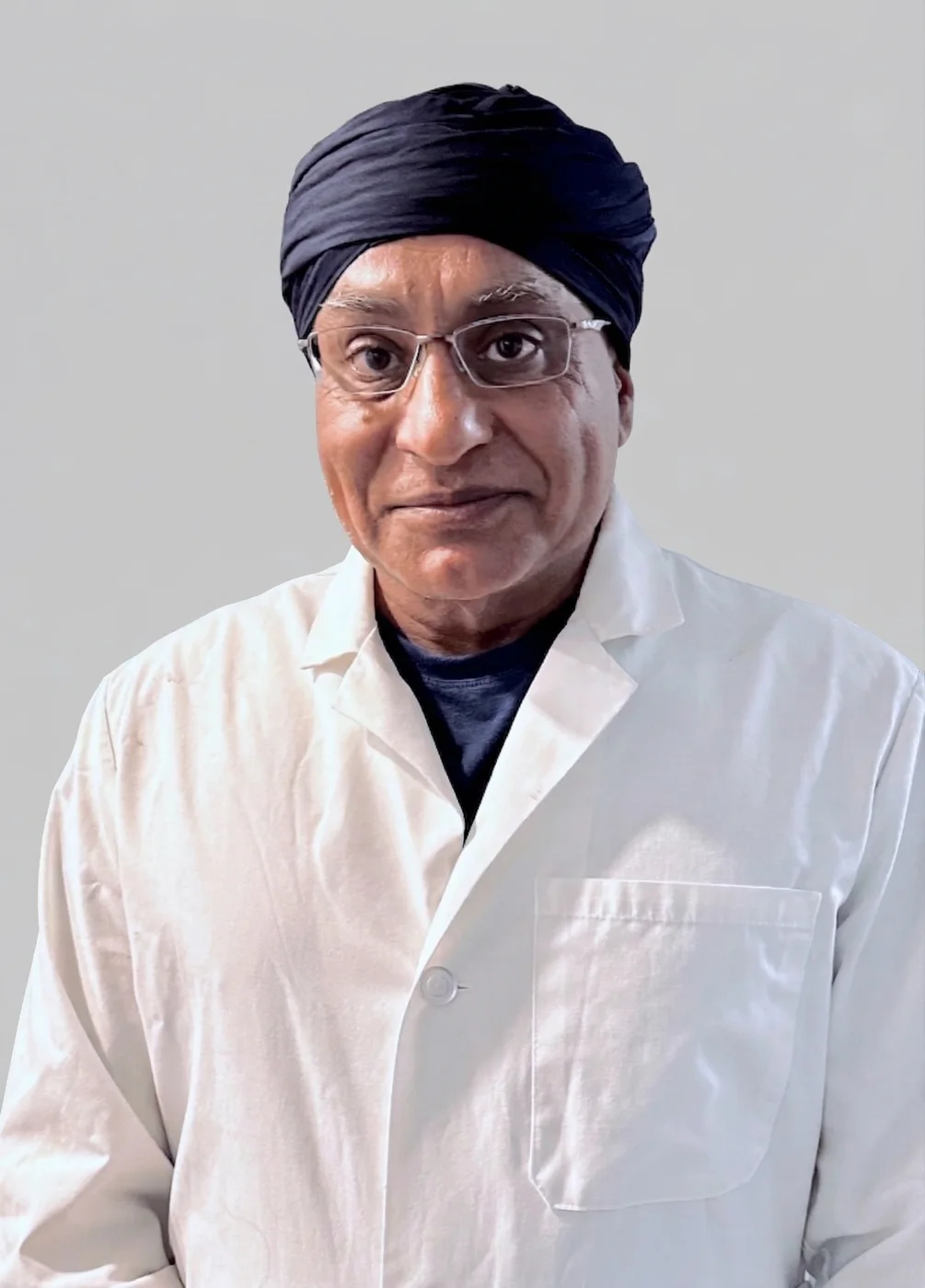
Dr. Gurpreet Singh Padda, MD, MBA, MHP is the medical director of painstl.com. He is a trauma-surgery-trained anesthesiologist turned interventional pain physician. He has run the Center for Interventional Pain Management since 2001.
Twenty years on the inside, then the switch
He trained the way the system wanted. He studied biology and medicine at UMKC and general surgery at Cook County Hospital. He did anesthesia residencies at Illinois Masonic and Washington University–Barnes, where he served as chief resident. Then he built the academic career that followed. He was assistant professor of anesthesiology and pediatrics at Saint Louis University, director of a pediatric acute pain service, and deputy director of the institutional review board. Along the way he was also a strict vegetarian. He preached the dietary guidelines to his patients. He told the ones with rising blood sugar that their numbers were “not too bad.”
He was wrong on both counts, and he says so first because the correction only means something once you have seen him be wrong. “Not too bad” was true against a reference range built for a healthy population. It was false against the number that really predicts the outcome. That number predicts who gets neuropathy, who fails to heal after a procedure, and who ends up back in this office a year later no better. A bite of beef on bun at a Kansas City barbecue counter ended the vegetarian argument faster than any journal article did. Both changes are why bloodwork is part of a pain visit at this practice, not a separate program sold afterward. They are also why the metabolic terrain gets equal time with the disc or the joint. Read why.
What is Dr. Padda board certified in?
Board certification is not one line here — it is five: anesthesiology, pain medicine, interventional pain management (ABIPP, DABIPP), addiction medicine and obesity medicine, plus a diplomate designation as a Metabolic Health Practitioner and fellowship recognition as a Fellow of Interventional Pain Physicians. Two added-competency certifications sit underneath that stack and rarely get mentioned on a physician bio anywhere: Coding, Compliance and Practice Management, and Controlled Substance Management. He treats compliance as a discipline he holds, not a rule forced on him. It is the same instinct that made him Deputy Director of a university IRB and a Department of Homeland Security civil surgeon.
Academic posts and the national platform
He has been faculty twice. The first time was at Cardinal Glennon and Saint Louis University in the 1990s. The second began in 2024, teaching pain and addiction to the KCU Freeman Health System psychiatry residency. Between those two stints he has published peer-reviewed work in Neuromodulation, Pain Medicine, Critical Care Medicine, Anesthesia & Analgesia and Pain Physician, served as a review editor for PharmacoEconomics, and delivered two ASIPP national keynotes — Treating Metainflammation and Interventional Pain in 2020 and Metabolic Inflammation and the Hedonic Treadmill in New Orleans in 2021 — along with a 2025 ASIPP talk on revenue enhancement through outcome measurement. The thread through all of it is the same one that runs through this website. Pain, metabolism and the economics of care are one subject, not three.
Leadership, because volume is not the same as outcome
He has chaired anesthesia and pain departments at two hospital systems. He served as a regional anesthesia director and ran a surgical ambulatory center. He led the Missouri Society of Interventional Pain Physicians as president in two separate decades. That is a manager’s résumé wrapped around a clinician’s license. The MBA sees a delayed diagnosis, or a procedure done without a diagnostic block first, as a preventable expense, not just a clinical miss.
Seva, and the foundation that runs alongside the practice
Seva means service given without expecting return, credit or exchange. It is the core principle behind the Sevadar Foundation, a 501(c)(3) he funds personally, currently self-funded. It runs three program DBAs, including an opioid-safety initiative and a federally listed patient safety organization. He has taken that same ethic on medical missions to Honduras, Guatemala and Nicaragua. He has also taken it onto the boards of Exoneration Nation, Arise Veterans and March of Dimes. From 2023 to 2026 he also sat on the boards of directors of two real estate development funds, Grocapitus Investments and UGRO.
How does Dr. Padda approach opioid prescribing?
“Not a gestapo policy. Harm reduction in the context of human frailty.” That is how he describes the real philosophy. The data behind it is uncomfortable enough to publish rather than soften. Patients who arrive here after 2.5 or more years of unmanaged pain average more than 90 morphine milligram equivalents a day. Under interventional treatment, 21% are fully weaned within 90 days and 34% within a year. Among the practice’s established, longer-term patients, fewer than 1% remain above 90 MME. Practice-reported figures from our own population, not trial outcomes, and individual results vary. The goal was never zero for its own sake. It is the smallest exposure that keeps someone functioning and out of withdrawal while the interventional plan takes over the work the opioid was doing. The full position.
Nationally, that same argument played out in public on International Overdose Awareness Day. Coverage of the crisis’s toll ran through outlets including the AP News wire. It is the backdrop this practice operates against, not a talking point made up for a webpage.
What does this mean for my appointment with Dr. Padda?
It means the person reviewing your case has been wrong before, in writing and in public, and changed course when the physiology told him to. It means bloodwork, sleep and behavior get discussed at a pain visit, not filed separately. It means a procedure gets explained as a test with an answer, not sold as a fix. And it means if you are on opioids already, the conversation starts from where you are, not from a lecture about where you should be. What to expect at the first visit.
Frequently asked questions
Is Dr. Padda actually a surgeon?
He trained in general surgery before anesthesiology and holds surgical privileges. The practice performs procedures such as stimulator and pump implants, nerve decompressions and microdiscectomy when conservative and interventional options run out. Surgery is matched to the condition. It is not offered or ruled out as a blanket policy. See spinal cord stimulation for one example of where that line sits.
Where is he licensed?
Missouri and Illinois. That covers the practical range of where patients on the Illinois side of the metro live and work.
What is a Metabolic Health Practitioner?
It is a diplomate credential from the Society of Metabolic Health Practitioners. It recognizes training in insulin resistance, metabolic inflammation and the diseases they lead to. It is the reason this practice treats metabolic health as part of a pain workup rather than a separate specialty.
Why does a pain clinic run a nonprofit?
Because seva, service without expecting anything back, is the stated core ethic behind the practice, not a marketing line. The clinical philosophy it produces shows up directly in how opioids are managed here.
Where did Dr. Padda train?
He studied biology and medicine at UMKC and trained in general surgery at Cook County Hospital. He completed anesthesia residencies at Illinois Masonic and Washington University–Barnes, where he served as chief resident. He then taught at Saint Louis University as an assistant professor of anesthesiology and pediatrics. After that he built the pain practice he has led since 2001.
How long has Dr. Padda been a pain doctor in St. Louis?
He has run the Center for Interventional Pain Management since 2001, after teaching at Cardinal Glennon and Saint Louis University in the 1990s. Since 2024 he has also taught pain and addiction to the KCU Freeman Health System psychiatry residency. He has served as president of the Missouri Society of Interventional Pain Physicians in two separate decades.
Do I have to come off opioids to be his patient?
No. If you already take opioids, the conversation starts from where you are, not from a lecture about where you should be. The goal is never zero for its own sake. It is the lowest exposure that keeps you functioning and out of withdrawal. Meanwhile the interventional plan takes over the work the opioid was doing. The full position is on the opioid stewardship page.
Related reading
- What to expect at the first visit
- Opioid stewardship
- The metabolic terrain and pain
- Sleep, movement and behavior
- Contact
BOARD CERTIFICATIONS, SOCIETIES AND AFFILIATIONS


You will be told what he thinks is happening, including when he is not sure
An appointment here starts with a history and an exam, and ends with a stated plan and a stated endpoint — not a referral back into the system that already failed to explain your pain.
4479 Woodson Rd, Suite 401
St. Louis, MO 63134
Next to St. Louis Lambert International Airport, off I-70 at Woodson Road.
As Seen In
Our releases ran on AP News, The National Law Review, FOX 2 St. Louis and 570+ other news sites across the United States and Canada.
- 12press releases
- 4,600+news placements
- 580+news outlets
- 110+TV station sites
- AP News
- The National Law Review
- FOX 2 St. Louis
- WGN-TV Chicago
- PIX11 New York
- KRON 4 San Francisco
- Detroit Free Press
- The Detroit News
- The Indianapolis Star
- The Tennessean
- Milwaukee Journal Sentinel
- The Arizona Republic
- The Des Moines Register
- The Cincinnati Enquirer
Distributed by EIN Presswire for Nectar Media Group.
In the press
- Dr. Gurpreet Singh Padda, MD: Trial Suggests PRP May Delay Knee Replacement for Patients Already on the Surgical List
EIN Presswire, October 12, 2026. For World Arthritis Day, what a randomized trial in bone-on-bone knees shows: two PRP injections beat cortisone and an anti-inflammatory on pain and function, and some patients put off surgery. - Dr. Gurpreet Singh Padda, MD Puts the New Low-Carb Guideline to Work in Pain Care: Medicines Change Before Pain Does
EIN Presswire, October 7, 2026. Covers the new Society of Metabolic Health Practitioners guideline on cutting carbohydrate safely, and why chronic pain patients with long medicine lists need it most.
Sources
- International Overdose Awareness Day coverage. AP News / EIN Presswire, 2026. AP News · EIN Presswire
- Hooten WM. Opioid Management: Initiating, Monitoring, and Tapering. Physical Medicine and Rehabilitation Clinics of North America, 2020. PubMed 32279729
- Sandhu HK et al. Reducing Opioid Use for Chronic Pain With a Group-Based Intervention: A Randomized Clinical Trial. JAMA, 2023. PubMed 37219554

