Pain management · Clayton, MO
A pain management second opinion after a Clayton surgical consult should change the plan, not just repeat it back to you.
Fifteen minutes from Clayton’s office towers and the Central West End’s surgical practices, this pain management clinic exists for two things. One is the desk-and-commute pain that builds quietly. The other is the second opinion that should truly rethink the case.
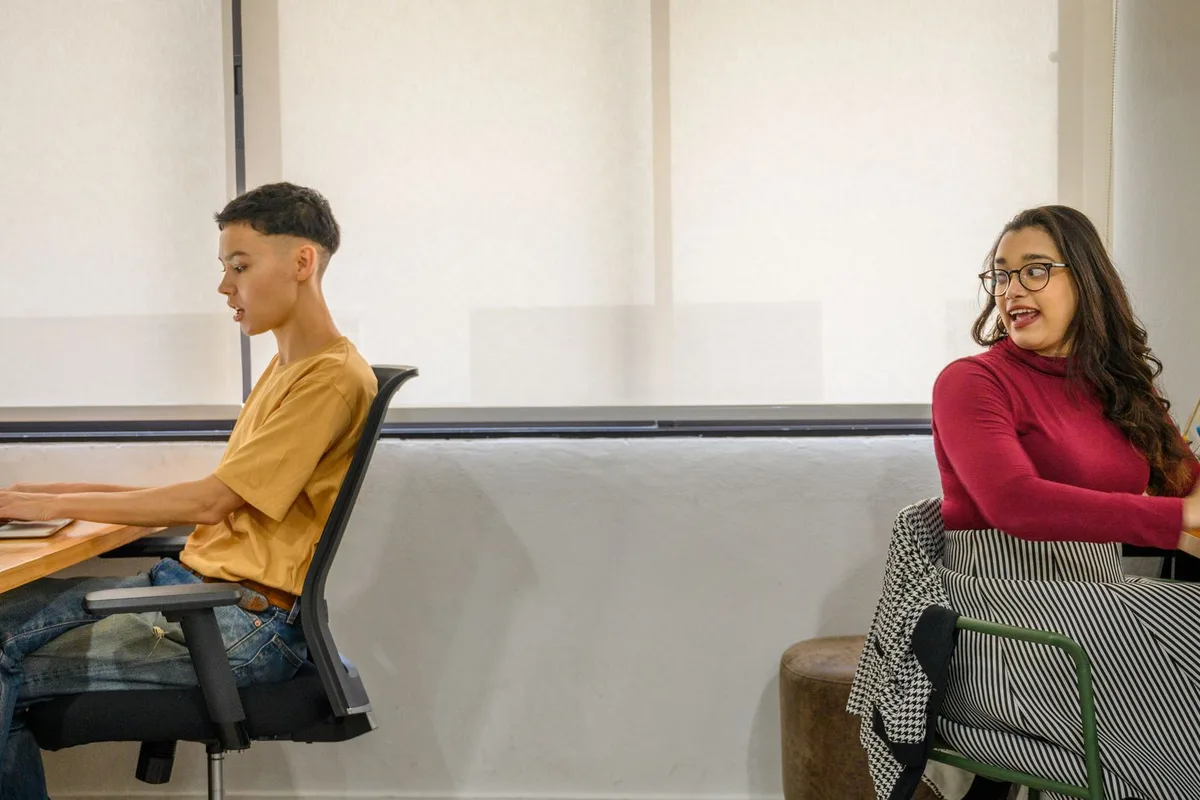
Why does sitting at a desk all day cause back and neck pain?
Clayton runs on people who sit for a living: county government, law firms, financial offices. Desk-and-commute pain has a shape you can spot. A low back that is worse by 3 p.m. A neck that has forgotten how to turn without a click. Hip flexors that shortened around eight hours of sitting and never stretched back out. Two body drivers usually do the damage. One is long, still loading of the lumbar discs and facet joints. The other is weakening of the deep core muscles whose job a chair does for you. Then one behavior driver closes the loop. A commute turns a sitting workday into a sitting evening, with no window in between to move.
It is worth naming why these patients often wait so long to call. A desk job rarely causes the kind of dramatic injury that forces a quick decision. There is no single moment to point to. There is just a slow wearing away of what a normal day feels like. Professionals who take pride in pushing through tend to push through this too, often for years. They stop when sitting through one meeting has become truly hard. By then, the mechanical problem is usually real and can be confirmed. It is not an exaggeration. And the delay has cost time the treatment plan now has to work around.
Fifteen minutes, most of it on I-170
From Clayton the drive is fifteen minutes free-flow and about nine miles, largely down I-170 to I-70 and off at Woodson Road, next to St. Louis Lambert International Airport. Add real time during the evening rush out of downtown. Midday and after 9 a.m. the interstate moves normally. Parking is free and immediate at the Woodson Road building. No garage, no meter, no circling a block the way a Central West End appointment often requires.
When should a second opinion change a surgery recommendation?
Patients often arrive here holding a surgical recommendation from a St. Louis or Clayton-area consult. They want confirmation, not a second look. A useful second opinion does something different. It asks whether the diagnosis was truly confirmed with a diagnostic block before surgery was proposed. It asks whether a facet or sacroiliac source was ruled out. And it asks whether conservative and interventional options were really used up first. Sometimes the answer is the same. Often it changes which structure gets treated, or whether an operation is called for yet at all.
Are injections enough for pain from sitting all day?
Interventional care buys the window. It does not replace what has to happen inside it. An epidural or facet injection can calm an acutely inflamed structure enough to move again. But the desk-and-commute pattern that built the problem does not go away on its own. It needs a specific movement plan built for you. Sometimes the pain has become the reason someone stopped moving at all. Then it also needs the behavior piece, delivered in-house by a pain-trained clinician using Acceptance and Commitment Therapy. Sending that work out to a referral most people never book is how a treatable mechanical problem turns into a chronic one.
Can insulin resistance make back pain worse?
A desk job does more than load the spine while you sit still. Over a career, it is also one of the more reliable ways to build insulin resistance. And insulin resistance is not a bystander in a Clayton office worker’s back pain. It is a participant. Picture a disc or facet joint inside a body running a chronically high inflammatory baseline. It hurts more than the same structure in a metabolically healthy body, for the same finding on imaging. That is one reason two people with nearly identical MRIs can feel very different pain. They can also respond very differently to the same injection. The work culture of long hours makes it worse. A job that prizes being seen at your desk tends to be the same job that makes a lunch walk feel like a treat instead of medicine.
That is why bloodwork is part of a Clayton evaluation, not a separate program offered later. Treating the disc while ignoring the metabolic terrain it sits in asks a local injection to beat a whole-body process. These patients spend most of their waking hours in an office chair. That terrain is worth mapping honestly. Do not assume it is fine because the person looks healthy.
Frequently asked questions
How long is the drive from Clayton?
About fifteen minutes free-flow, mostly down I-170 to I-70, off at Woodson Road next to the airport. See the full St. Louis service map for how that compares from other parts of the county.
I already have a surgical recommendation. Do I need a referral to get a second opinion here?
No referral is required. Bring your imaging and the surgical note, and the visit goes ahead as a direct evaluation. If your surgeon or primary doctor wants to coordinate directly, the for physicians page covers how that works.
What should I expect walking in for the first time?
It is a diagnostic visit, not a procedure day. It includes a physical exam, an imaging review, and bloodwork where needed, detailed on the what to expect page.
Which procedures actually help desk-and-commute back pain?
Often an epidural steroid injection paired with a specific movement plan. The exact answer depends on which structure the exam and imaging confirm as the source.
Is parking easy at the clinic?
Yes. Parking is free and immediate at the Woodson Road building, with no garage, no meter and no circling a block the way a Central West End appointment often requires. From Clayton the drive is about nine miles, mostly down I-170 to I-70. Allow extra time during the evening rush out of downtown; midday and after 9 a.m. the interstate moves normally.
Why can two people with the same MRI have different back pain?
Because the MRI shows the structure, not the terrain it sits in. A disc or facet joint inside a body running a chronically high inflammatory baseline hurts more than the same structure in a metabolically healthy body. That holds for the same finding on imaging. Insulin resistance, which a desk career reliably builds, is a participant in that pain. It changes how well the same injection works.
Why is bloodwork part of a back pain visit?
Treating a disc without looking at the metabolic terrain around it asks a local injection to beat a whole-body process. Some people spend most of their waking hours in an office chair. For them, that terrain is worth mapping honestly. Do not assume it is fine because the person looks healthy. That is why bloodwork, where needed, is part of a Clayton evaluation, not a separate program offered later.
Related reading
- Pain management in St. Louis
- Facet joint pain
- Sacroiliac joint pain
- When injections stop working
- What to expect
- Pain management in Ladue, MO
- Pain management in Richmond Heights, MO
A second opinion should be able to change the plan
Bring the imaging and the surgical note. We will tell you plainly whether the diagnosis holds up or whether a different structure explains what you feel.
4479 Woodson Rd, Suite 401
St. Louis, MO 63134
Next to St. Louis Lambert International Airport, off I-70 at Woodson Road.
Sources
- Bontrup C et al. Low back pain and its relationship with sitting behaviour among sedentary office workers. Applied Ergonomics, 2019. PubMed 31422243
- Baradaran Mahdavi S et al. Association between sedentary behavior and low back pain; A systematic review and meta-analysis. Health Promotion Perspectives, 2021. PubMed 35079583
- Matthies N et al. An Exploratory Analysis of Spine Patients’ Preoperative Concerns and Decision-making Process: Does What Surgeons Say Matter? Spine, 2020. PubMed 32675614