Pain management · Hazelwood, MO
Hazelwood pain management for the forklift, the pallet and the same low back, three shifts a week, at the employers ringing this airport.
Hazelwood’s economy runs on the distribution centers and plants around Lambert Airport — forklift operators, pallet handlers, assembly workers. They are twelve minutes from a pain management clinic built for exactly that kind of repetitive strain.
What work injuries do Hazelwood patients bring in?
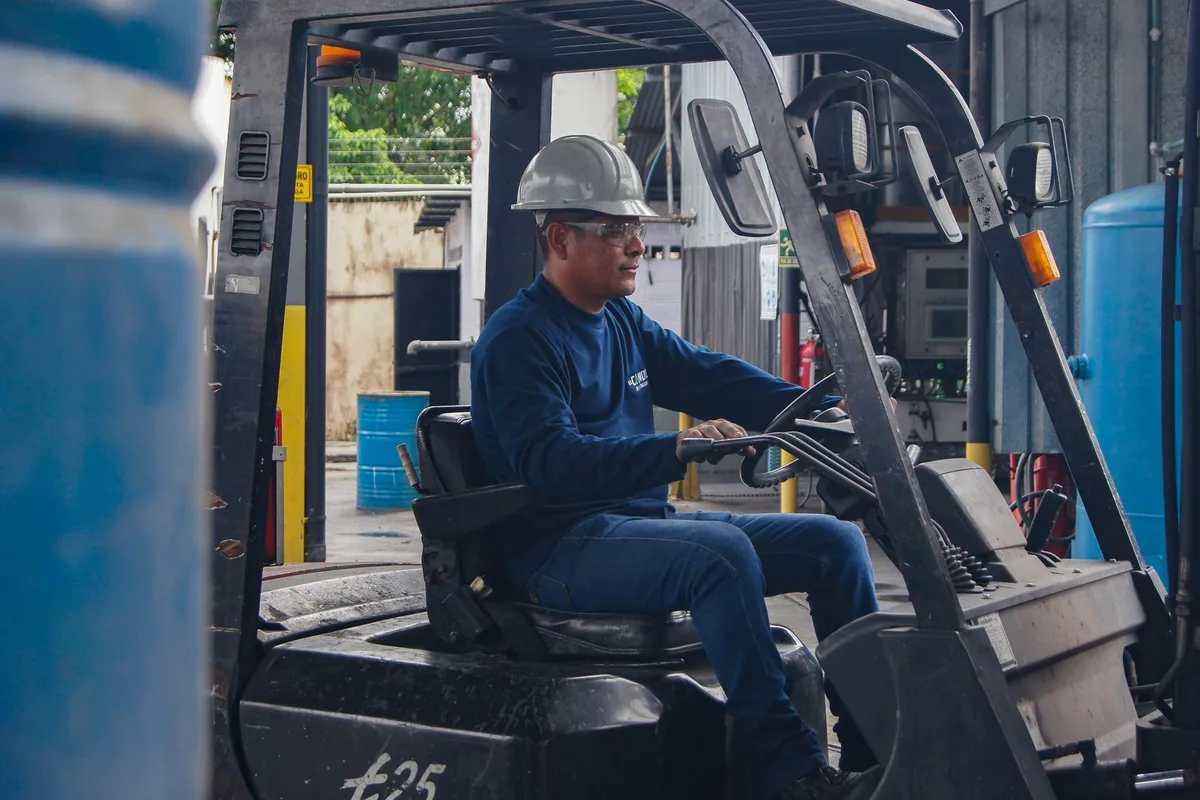
Hazelwood is built around the plants and warehouses that cluster near Lambert Airport — warehousing, light manufacturing, airport-linked shipping. The injuries this practice sees from Hazelwood follow the job. Forklift operators carry a documented, specific low back injury risk. It comes from the whole-body vibration and jarring of the machine itself, apart from any lifting they do off it. Pallet handlers and line workers carry a different but related pattern. It is repetitive strain from the same motion done hundreds of times a shift. It does not announce itself as an injury the way a single bad lift does — it builds up.
A third pattern shows up almost as often as the first two. An older worker in a physical job has quietly worked around a growing problem for years. They adjusted posture and technique and never called it an injury. Then a routine shift finally tips it into something acute. That worker often assumes nothing can be done because the problem feels like it has been there forever. That is exactly backwards. Years of working around pain is still a mechanical problem. There is a real structure behind it, and it can be found. It is not a permanent condition to be managed around forever.
How far is the clinic from Hazelwood, and can I fit it between shifts?
From Hazelwood the drive is twelve minutes free-flow and 6.2 miles. Most of it runs on roads that already link the industrial park to I-70. You exit at Woodson Road next to the airport. Shift-change traffic around the larger employers adds a few minutes at set hours. Otherwise the route is short and direct. Parking is right at the building. That matters for a visit squeezed between a shift ending and a family duty starting.
Being close matters more here than it might for an office worker, because plant shifts rarely bend for a doctor visit the way a salaried job’s calendar sometimes does. A twelve-minute drive can really fit into a lunch break, a shift-change gap, or the hour before a second job starts. A forty-minute drive across the county usually cannot.
Why do a forklift back injury and a repetitive-strain shoulder need different workups?
Forklift-related low back injury is driven by two biological factors that stack up. One is the built-up mechanical load of whole-body vibration on the lumbar discs. The other is inflammatory sensitization, which makes any part loaded over and over more reactive with time. The money driver under both is simple: production quotas rarely build in recovery time between exposures. Repetitive strain in the shoulder or wrist from assembly or order-picking work follows a similar mechanism at a smaller joint. Both patterns respond poorly when lumped into one generic “back pain” or “shoulder pain” complaint, instead of the specific structure actually failing under repeated load.
What does a work comp evaluation have to prove?
An injured at work claim from a Hazelwood employer needs the same thing every legitimate claim needs. It needs a diagnosis tied to a specific structure, matched with imaging and a physical exam. It needs records that state plainly how the injury happened and what would count as improvement. That standard protects the worker as much as it satisfies the claim. A vague diagnosis is the one that gets challenged, delayed, or denied outright. A precise one is the one that actually gets treated right the first time.
Why does a delayed work comp claim make the injury worse?
A work comp claim that drags on does two kinds of damage at once, and only one of them shows up on a pay stub. The financial cost of a delayed or denied claim is real and well documented. But the physical cost builds alongside it. A structure that could have been treated early with an image-guided injection instead sits inflamed for months while paperwork moves. Inflammation left alone that long changes how the tissue responds to treatment once it finally arrives. The two feed each other. The longer the claim is contested, the more the untreated structure has degraded. And the more degraded the structure, the harder it is to make the first, simpler treatment plan work by the time it is finally approved.
That is a large part of why a precise, well-documented diagnosis matters so much for an industrial workforce. It is not paperwork for its own sake. It is what keeps the medical timeline from falling behind the paperwork one.
Frequently asked questions
I operate a forklift and my back has been getting worse for months. Is that a work comp case?
It can be. Repetitive-strain injuries that build up over time are recognized work comp claims in Missouri. The injured at work page explains what the evaluation needs to document.
Is parking difficult near the office, like at the industrial park?
No. Parking is right at the building, with directions on the contact page.
What procedures help repetitive strain from assembly or order-picking work?
Often trigger point injections paired with a modified-duty plan. The exact approach depends on which structure the exam and imaging point to.
How long is the drive from Hazelwood?
Twelve minutes free-flow, close to the industrial park along roads that already connect to I-70. The full regional map is on the St. Louis page.
What treatment does a pain doctor use for a forklift or repetitive-strain injury?
Treatment follows the structure that is failing, not a generic label of back pain or shoulder pain. For repetitive strain from assembly or order-picking work, that is often trigger point injections paired with a modified-duty plan. An inflamed structure can be treated early with an image-guided injection. The exam and imaging decide which approach fits. That way the plan targets the actual source of the pain.
What should I tell a pain management doctor about a work injury?
Tell us the job and the specific motion that hurts. That detail usually points straight at which structure is failing under repeated load. Think of the lumbar discs of a forklift operator, or the shoulder or wrist of an order picker. It is also exactly what a work comp claim needs on record: how the injury happened, tied to a specific structure.
Can a back problem I have worked around for years still be treated?
Yes. Many workers in physical jobs quietly adjust their posture and technique around a growing problem for years. Then a routine shift tips it into something acute. Years of working around pain is still a mechanical problem. There is a real structure behind it, and it can be found. It is not a permanent condition to be managed around forever, and the workup is built to find that structure.
Related reading
- Injured at work
- Trigger point injections
- Image-guided joint injections
- Pain management in Ferguson
- For physicians
A repetitive injury deserves a precise diagnosis, not a generic one
Tell us the job and the specific motion that hurts. That detail usually points straight at which structure is actually failing, and it is what a work comp claim needs documented anyway.
4479 Woodson Rd, Suite 401
St. Louis, MO 63134
Next to St. Louis Lambert International Airport, off I-70 at Woodson Road.
Sources
- Waters T et al. Lower back disorders among forklift operators: an emerging occupational health problem? American Journal of Industrial Medicine, 2005. PubMed 15776473
- Kheiri SK et al. Functional ANOVA for Upper Extremity Fatigue Analysis during Dynamic Order Picking. IISE Transactions on Occupational Ergonomics and Human Factors, 2023. PubMed 38536045
- Kurustien N et al. Trunk Muscle Performance and Work-Related Musculoskeletal Disorders among Manual Lifting with Back Belt Wearing Workers. Journal of the Medical Association of Thailand, 2015. PubMed 26387415