T raise exercise · shoulder pain
The T raise exercise strengthens the middle of the upper back, which pulls rounded shoulders back into line.
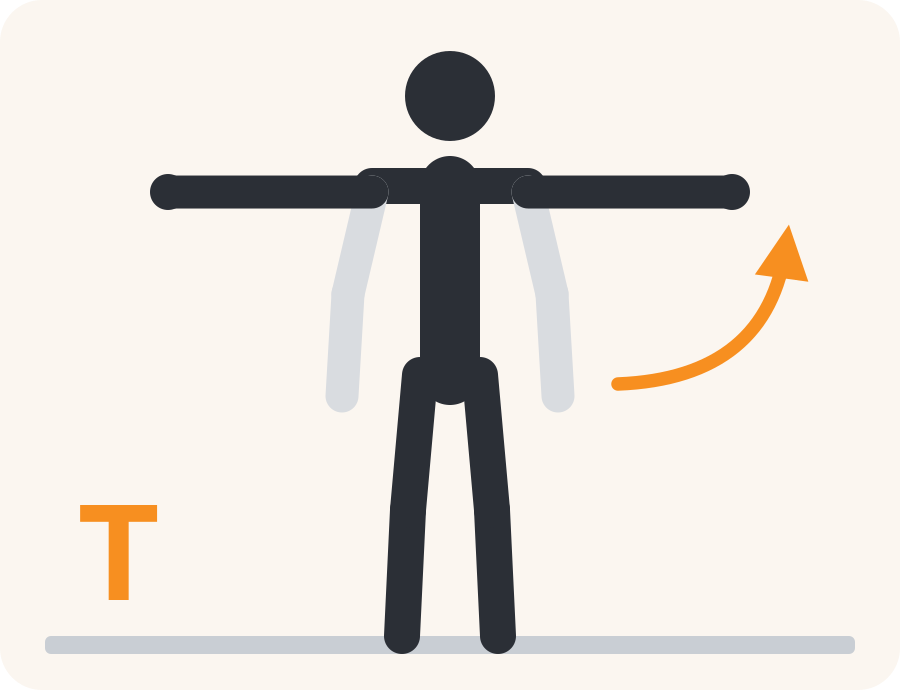
The T raise is a home shoulder exercise: standing tall with thumbs up, you pinch your shoulder blades toward each other, then open both straight arms sideways to shoulder level, spelling a T, hold 3 seconds, and lower slowly, 10 times.
Skip this one unless it is marked on the home program your physician gave you. Unless your instructions say otherwise, do your marked exercises twice a day, every day, and tick off each session in your log.
Step by step: the T raise
- Set up: Stand or sit tall, arms at your sides, thumbs up.
- Move: Pinch the shoulder blades toward each other. Open both straight arms sideways, stopping level with your shoulders, to form a T. Lower slowly.
- Count and hold: Hold 3 seconds. Repeat 10 times. Twice a day.
Why the T raise matters after a procedure
The middle trapezius and the rhomboids hold the shoulder blades back against the ribs. Weakness here lets the shoulders roll forward, which narrows the space the rotator cuff passes through and loads the neck. The T raise is the third letter in the series and focuses on that pull-back. It helps a worn shoulder joint move in a better position.
Which mistakes undo it?
- Lifting above shoulder height.
- Bending the elbows.
- Leaning backward.
When to stop for the day
Expect a mild stretch, some effort, and maybe a little soreness the next morning. Quit for the day and phone (314) 886-5620 if you get:
- Numbness, tingling or weakness that was not there before
- A sharp, stabbing pain
- Pain that rises 2 points or more above your starting number and does not settle within an hour
- Lightheadedness, or your vision changing
Fainting, chest pain or a struggle to breathe: dial 911, not our office.
What to remember
- Squeeze the shoulder blades, then lift.
- Shoulder height is the ceiling.
- Arms straight, body still.
Last step. Show us you have it: Right here in the clinic, demonstrate the T and stop with your hands level with your shoulders. Unsure about any step? We run through it with you again next time.
Why bring your exercise log?
The log is how we tell the difference between an exercise that is not working and an exercise that is not being done. At each visit your technician counts the sessions you checked off, notes your daily pain number, and watches you do one exercise to correct your form before small errors become habits.
Related reading
- The painstl.com physiotherapy program, every station and test
- Pendulum, another shoulder exercise
- Wall walk, another shoulder exercise
- Outward turn with band, another shoulder exercise
- Band row, another shoulder exercise
- I raise, another shoulder exercise
- Y raise, another shoulder exercise
- A press, another shoulder exercise
Need the plan built around your injection?
A physician examines you first and decides which shoulder exercises fit your diagnosis and the procedure you had.
4479 Woodson Rd, Suite 401
St. Louis, MO 63134
Next to St. Louis Lambert International Airport, off I-70 at Woodson Road.