Knee or hip pain weeks after an injury · St. Louis
Knee or hip pain weeks after an injury: why it waits until you walk again
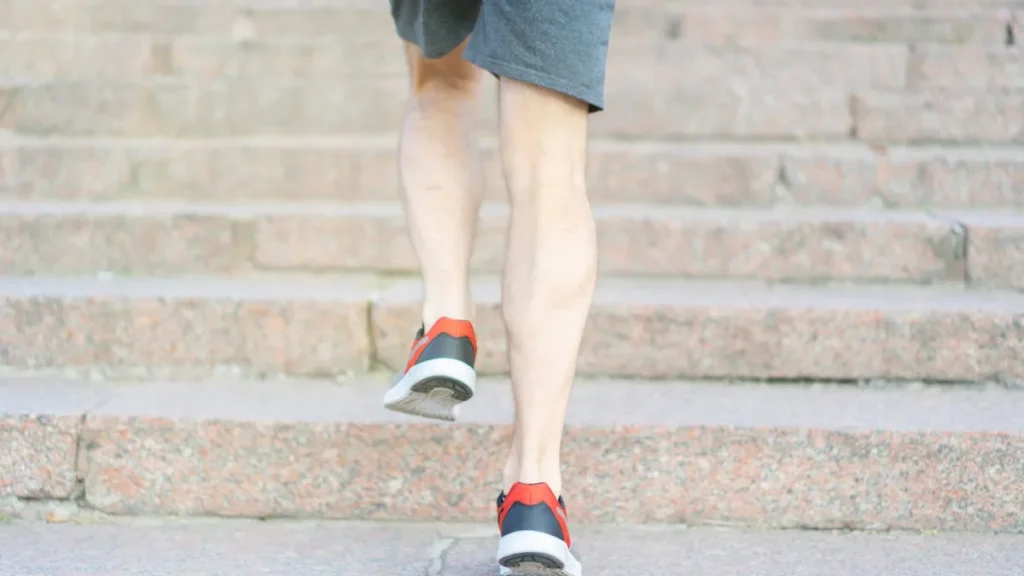
Because the meniscus, the knee ligaments and the hip labrum are load-bearing parts, and a torn load-bearing part can sit quietly while you rest. The pain arrives when the joint is asked to work again: the first flight of stairs, the first full day on your feet, the first pivot on a planted foot. That timing is what these tissues predict, not a sign of a new injury.
Why would a torn knee or hip stay quiet for weeks?
A chair with a cracked leg stands fine in the corner and fails the moment someone sits. A torn meniscus or labrum behaves the same way, and three things hide it early.
The nervous system turns the volume down. Melzack and Wall’s 1965 gate control model puts a checkpoint in the spinal cord, where touch and pressure input and commands from the brain can damp injury signals.4 Under the stress of an injury, those brain systems suppress pain on purpose, and how strongly they do it varies widely between people.5
The loud injury takes the attention. A broken ankle, a fractured shin or cracked ribs get the cast, the boot and the follow-up visits. The knee above the fracture rarely gets a careful exam while the bone is the emergency.
The joint never gets loaded. On crutches, in a boot or on the couch, the meniscus and labrum carry almost nothing. Inflammation builds over days, but the real test comes when weight returns. That is why the pain so often starts the week you go back to walking, not the week you got hurt.
Which parts of the knee and hip behave this way?
The meniscus is a pair of C-shaped cushions between the thigh bone and the shin bone. The MCL runs along the inner side of the knee and keeps it from buckling inward. The labrum is a rim of cartilage that deepens the hip socket and seals it. On a scan, all of these count as “soft tissue,” which is imaging shorthand for anything that is not bone.
A fracture remodels back into bone. A torn ligament, meniscus or labrum mends with scar if it mends at all, and some regions of both the meniscus and the labrum get so little blood that repair is slow and partial. Scar is stiffer and weaker than the tissue it replaces, so the joint carries load unevenly from then on. That is how a “minor” soft tissue injury can outlast the broken bone next to it.
How long can a hip labral tear go undiagnosed?
Far longer than most people expect. A study from Washington University in St. Louis followed 66 patients whose labral tears were confirmed by arthroscopy. On average they waited 21 months from the first symptom to the diagnosis and saw 3.3 health care providers along the way. In 11 of them (17%), surgery had been recommended on some other part of the body. The pain began gradually in 40, after a low-energy injury in 20 and after major trauma in 6.1 A labral tear shows up as a deep groin ache, a click or catch when you turn, or pain that builds with long sitting. It is easy to blame on the back.
Does a broken leg hide damage in the knee?
Frequently, though not all of it matters. Researchers took MRIs of 42 knees sitting above an isolated shin-bone fracture: 41 (97.6%) showed at least one injury, 35 involved a ligament and 5 had a medial meniscus tear. Most of those injuries were not clinically relevant, and they healed; the average knee function score at follow-up was 99 out of 100.2 So a finding on MRI is not automatically a problem. The exam decides that.
The ones that do matter still get found late. A series of 448 patients with breaks around the knee turned up 35 PCL injuries (7.8%), and 22 of those were not detected until later.3 My own October crash followed the same script. The trauma CT found the ankle and leg fractures and the broken ribs on day one, and I was back to full activity by October 26. Over the next several weeks, with full load on the leg, my left knee and left hip started to object, and ultrasound, not CT, found why: tears of the meniscus and the MCL in the knee and of the labrum in the hip.
What do we check when the knee or hip starts hurting late?
We watch you walk and climb, then test each ligament for laxity, press along the joint line, put the meniscus under controlled stress and take the hip through the positions that pinch a torn labrum. The exam picks the test. MRI answers questions about the meniscus, ligaments and labrum; ultrasound images many of the same parts while they move; a nerve test of the leg sorts out pain that is really coming from a nerve root in the back. Treatment options are on our knee pain, hip pain and image-guided joint injection pages.
One thing you control starts today: keep the joint moving within what it tolerates. Muscle that goes unused shrinks within weeks, and the thigh and hip muscles are a large share of the shock absorption those joints rely on. Resting a torn meniscus until it stops hurting usually means it hurts again the day you stop resting.
Skip the appointment and call 911 or head to the ER if a leg suddenly goes weak, you can no longer control your bladder or bowels, a foot or leg turns cold or pale, you have chest pain or can’t catch your breath, or a headache keeps climbing.
Common questions
Can a meniscus tear start hurting weeks after the injury?
Yes. A torn meniscus often hurts little while you rest or stay off the leg. Pain, swelling, locking or a sense of the knee giving way tend to appear once you are walking, squatting or turning on it again.
Is a deep groin ache after a fall a hip problem?
It can be. Groin pain, clicking or catching, and pain after long sitting are typical of a hip labral tear, which is often blamed on the back or a strained muscle at first. An exam of the hip itself is the place to start.
If my MRI shows a knee injury, will I need surgery?
Not necessarily. In one study, nearly every knee above a shin fracture showed some injury on MRI, yet most of those injuries were not clinically relevant and healed. The exam and how the knee works decide what needs treating.
Walking again and the joint is complaining?
Tell us what you were doing when the pain started. We examine the knee or hip, find which tissue is involved and order the test that fits.
4479 Woodson Rd, Suite 401
St. Louis, MO 63134
Next to St. Louis Lambert International Airport, off I-70 at Woodson Road.
Sources
- Burnett RSJ, Della Rocca GJ, Prather H, Curry M, Maloney WJ, Clohisy JC. Clinical presentation of patients with tears of the acetabular labrum. The Journal of Bone and Joint Surgery. American Volume, 2006;88(7):1448-57. doi:10.2106/JBJS.D.02806
- Guler F, Kose O, Erol B, Turan A, Koroglu M, Akalin S. The prevalence of knee injuries ipsilateral to tibial shaft fractures and their impact on clinical outcome. European Journal of Orthopaedic Surgery & Traumatology, 2015;25(1):141-8. doi:10.1007/s00590-014-1465-5
- Kim JG, Lim HC, Kim HJ, Hwang MH, Yoon YC, Oh JK. Delayed detection of clinically significant posterior cruciate ligament injury after peri-articular fracture around the knee of 448 patients. Archives of Orthopaedic and Trauma Surgery, 2012;132(12):1741-6. doi:10.1007/s00402-012-1605-5
- Melzack R, Wall PD. Pain mechanisms: a new theory. Science, 1965;150(3699):971-9. doi:10.1126/science.150.3699.971
- Butler RK, Finn DP. Stress-induced analgesia. Progress in Neurobiology, 2009;88(3):184-202. doi:10.1016/j.pneurobio.2009.04.003