IMAGE-GUIDED JOINT INJECTIONS
The hip capsule sits deep enough that feel alone finds muscle first. Imaging is what finds the joint.
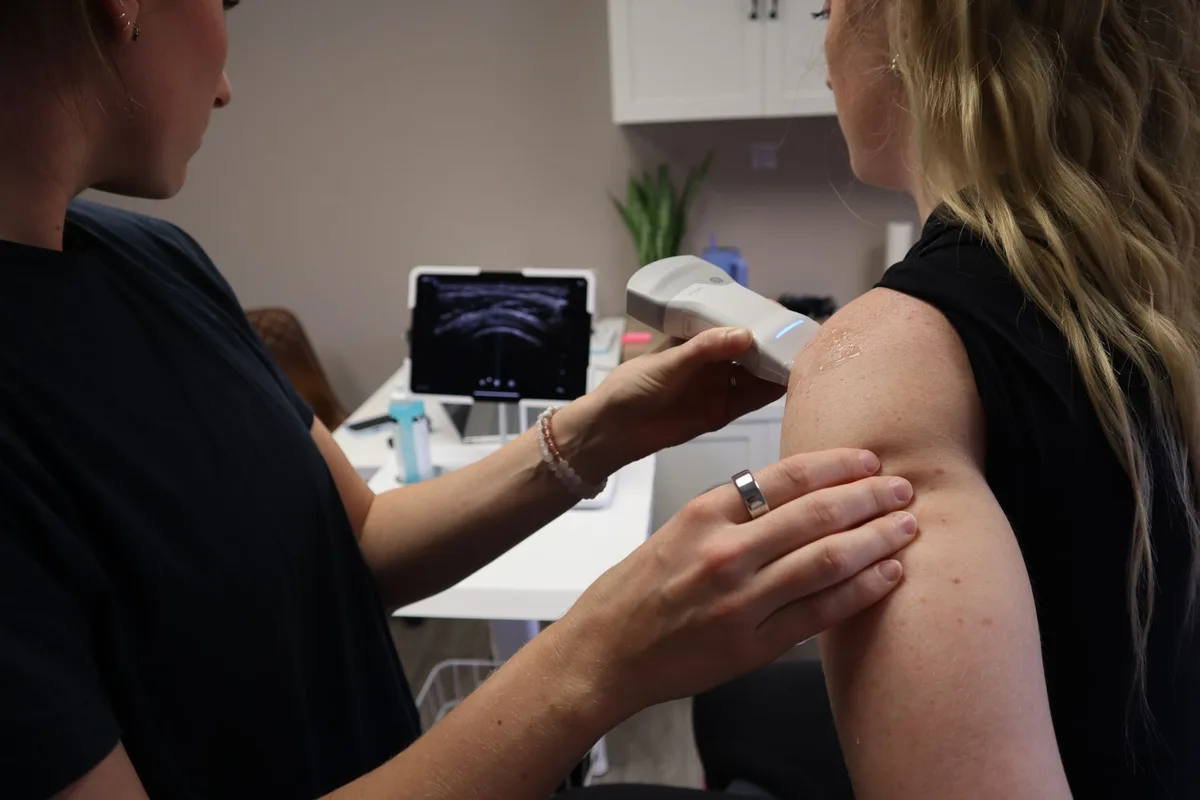
Hip, shoulder and knee injections done under fluoroscopy or ultrasound place medication precisely inside the joint capsule rather than near it, which matters for treatment and matters just as much for diagnosis — a joint that lights up with relief from local anesthetic has just told you it was the source all along.
Why the needle needs to be guided
A study of sonographically guided hip injections found that even in an adult with normal anatomy, landmark-based placement without imaging misses the joint capsule often enough that the practice has largely moved away from it for the hip specifically — the joint sits deep under muscle, and feel alone cannot reliably distinguish capsule from the tissue surrounding it. The shoulder has a similar problem: a systematic review and meta-analysis comparing image-guided against blind glucocorticoid injection for shoulder pain found the guided approach reached the target more reliably and produced better outcomes. The knee is more forgiving because the joint line is easier to palpate, but even there, imaging confirms placement rather than assumes it. We use fluoroscopy or ultrasound for all three, not because the technology is impressive, but because a joint injection that misses the joint treats nothing and tells you nothing.
What goes into the joint
CORTICOSTEROID
The standard first option for an inflamed joint, reducing synovitis directly. Effective and inexpensive, with the same systemic caveats as steroid anywhere else — a transient rise in blood sugar, and a reason this practice does not run standing courses of it.
HYALURONIC ACID
A viscosupplement rather than an anti-inflammatory, aiming to restore some of the joint’s natural lubrication. Most established in the knee, with a slower onset and, in appropriate candidates, a longer window of benefit than steroid.
ORTHOBIOLOGICS
Platelet-rich plasma and bone marrow aspirate concentrate, prepared from your own blood or marrow and delivered into the joint. These are non-covered by most insurers — a coverage decision, not a verdict on whether they work — and patients sign an acknowledgment of that before proceeding. The evidence behind them keeps growing; the reimbursement policy simply has not caught up to it the way it has for an older, cheaper option.
The diagnostic value
Hip pain and low back pain overlap in presentation more than either patient or referring provider usually expects — pain felt in the groin or lateral hip can originate from the lumbar spine, and pain felt in the low back and buttock can originate from the hip joint itself. Shoulder and neck pain have the same problem: a cervical nerve root can refer pain into the shoulder in a pattern that mimics a rotator cuff or joint problem exactly. A local-anesthetic-only injection into the joint, done under imaging so we know it actually reached the capsule, answers the question directly. Substantial relief within minutes implicates the joint. Minimal relief points the workup back toward the spine.
The terrain around a worn joint
A joint does not wear out from mechanics alone. Insulin resistance and metainflammation degrade cartilage and synovium at the biochemical level, and excess load from carrying more weight than the joint was built for accelerates the same process mechanically — two drivers working the same joint from different directions. A job that keeps you on your feet on hard surfaces all day, with little room to modify how you move through pain, is the social and behavioral piece completing the picture. An injection addresses the joint in front of us. It does not touch the terrain that wore it down, which is why bloodwork and a conversation about metabolic health and pain are part of this visit rather than an upsell afterward.
The evidence, honestly
Guideline reviews of hip and knee osteoarthritis management consistently place intra-articular corticosteroid as reasonable short-term therapy and are more measured about hyaluronic acid, with recommendations that vary by guideline body. A 2024 network meta-analysis comparing orthobiologic options directly against corticosteroid for knee osteoarthritis found platelet-rich plasma, bone marrow aspirate concentrate and hyaluronic acid all outperformed corticosteroid on pain and function at six months and beyond, while corticosteroid remained the fastest-acting option in the short term. That is a genuinely useful, nuanced finding rather than a verdict in either direction: steroid for a fast, short window; orthobiologics for patients prioritizing durability who accept the cost is theirs to carry. We present both honestly rather than defaulting to whichever this practice happens to prefer.
What happens on the day
- Joint exam and pain map recorded, including what movements reproduce the pain.
- Positioned for the specific joint, skin cleaned and anesthetized.
- Needle advanced under fluoroscopy or ultrasound directly into the joint capsule, confirmed on-screen before anything is delivered.
- Medication injected, and the needle removed.
- Same-day tracking. If local anesthetic was included, note how much relief you get in the first few hours — that is diagnostic, independent of the treatment effect.
Risks, in plain language
Soreness for a day or two is common. Infection inside a joint is rare but serious, which is why sterile technique is non-negotiable and why worsening pain, redness, warmth or fever after the injection is not something to wait out — call us. Steroid raises blood glucose transiently, more noticeably in diabetic patients, and repeated exposure over time has effects on nearby cartilage and bone that are part of why this practice does not run standing courses. Orthobiologic preparations carry the risks of the blood or marrow draw itself, generally minor, plus the same small infection risk as any joint injection.
Common questions
How do you decide between steroid, hyaluronic acid and orthobiologics?
Based on the joint, how quickly you need relief, what you have already tried, and whether the added cost of a non-covered orthobiologic option is one you want to carry. We lay out the honest tradeoffs rather than steering you toward one by default — see knee pain for the condition-specific version of this decision.
If insurance won’t cover PRP, does that mean it doesn’t work?
Non-coverage is a decision insurers make about which treatments they will pay for, not a judgment on the evidence behind them. Orthobiologics have a real, growing evidence base, and how that fits into your options is covered plainly at what to expect; they are simply not reimbursed the way older treatments are.
Could my hip pain actually be my back?
Often enough that we check both. A diagnostic injection under imaging is one of the more reliable ways to settle it — see hip pain and sciatica for how the two are told apart on exam first.
How many injections can I have?
No fixed number or pre-booked course. Each is weighed against what the last one achieved and the cumulative effects of whatever was used — see when injections stop working.
Will this fix my shoulder pain permanently?
It treats inflammation or lubrication inside the joint; it does not repair a torn structure or reverse arthritis, a limit also covered on when injections stop working. If imaging shows a repairable tear, that is a surgical conversation we will have with you directly.
Related reading
We will confirm the needle reached the joint before we call the injection done
Imaging is not an upsell here, it is the standard. You will see the confirmation on screen and know exactly what was placed and where.
4479 Woodson Rd, Suite 401
St. Louis, MO 63134
Next to St. Louis Lambert International Airport, off I-70 at Woodson Road.
Sources
- Smith J et al. Accuracy of sonographically guided intra-articular injections in the native adult hip. Journal of Ultrasound in Medicine, 2009. PubMed 19244069
- Bloom JE et al. Image-guided versus blind glucocorticoid injection for shoulder pain. Cochrane Database of Systematic Reviews, 2012. PubMed 22895984
- Jawanda H et al. Platelet-Rich Plasma, Bone Marrow Aspirate Concentrate, and Hyaluronic Acid Injections Outperform Corticosteroids in Pain and Function Scores at a Minimum of 6 Months as Intra-Articular Injections for Knee Osteoarthritis: A Systematic Review and Network Meta-analysis. Arthroscopy, 2024. PubMed 38331363