Bridge exercise · low back pain
The bridge exercise builds the hip muscles that carry the load your low back has been carrying alone.
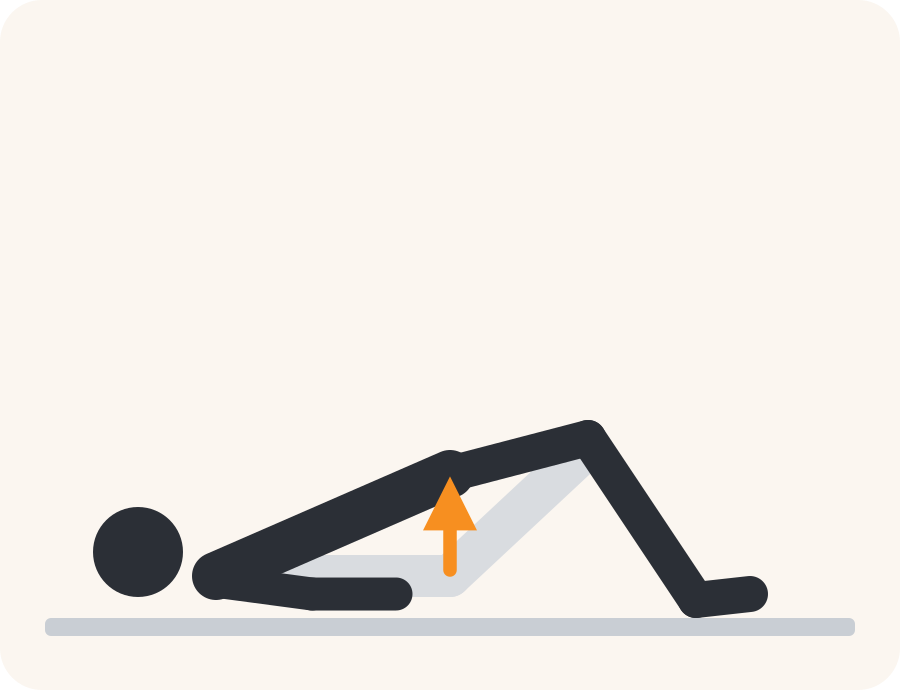
The bridge is a home low back and hip exercise: lying on your back with knees bent, you clench your buttocks and push your hips toward the ceiling until your body runs in one line from shoulder to knee, hold five seconds, 10 times.
Skip this one unless it is marked on the home program your physician gave you. Unless your instructions say otherwise, do your marked exercises twice a day, every day, and tick off each session in your log.
Step by step: the bridge
- Set up: Lie face up with knees bent and feet planted hip-width apart.
- Move: Clench the buttocks, then push the hips up until shoulder, hip and knee fall in one line. Lower yourself slowly.
- Count and hold: Hold 5 seconds at the top. Repeat 10 times. Twice a day.
Why the bridge matters after a procedure
The gluteal muscles are the biggest muscles you own, and they are meant to do most of the work of standing, lifting and climbing. When they weaken, the low back picks up the slack, and the joints that were just treated get overloaded again. Stronger hips protect the result of the procedure. That matters even more for pain below the belt line.
Which mistakes undo it?
- Arching the back to get higher at the top.
- Pressing your head or neck into the floor to push up.
- Letting your knees drift together or fall apart.
When to stop for the day
Expect a mild stretch, some effort, and maybe a little soreness the next morning. Quit for the day and phone (314) 886-5620 if you get:
- Numbness, tingling or weakness that was not there before
- A sharp, stabbing pain
- Pain that rises 2 points or more above your starting number and does not settle within an hour
- Lightheadedness, or your vision changing
Fainting, chest pain or a struggle to breathe: dial 911, not our office.
What to remember
- Squeeze the buttocks first, then lift.
- A straight line, not an arch.
- Knees stay hip-width apart.
Last step. Show us you have it: Right here in the clinic, demonstrate one bridge, holding the top for a slow count of five. Unsure about any step? We run through it with you again next time.
Why bring your exercise log?
The log is how we tell the difference between an exercise that is not working and an exercise that is not being done. At each visit your technician counts the sessions you checked off, notes your daily pain number, and watches you do one exercise to correct your form before small errors become habits.
Related reading
- The painstl.com physiotherapy program, every station and test
- Pelvic tilt, another low back exercise
- Knee to chest, another low back exercise
- Cat and cow, another low back exercise
Need the plan built around your injection?
A physician examines you first and decides which low back exercises fit your diagnosis and the procedure you had.
4479 Woodson Rd, Suite 401
St. Louis, MO 63134
Next to St. Louis Lambert International Airport, off I-70 at Woodson Road.